
How to Move a Washing Machine Down Stairs in 7 Steps
One day, I received a call from a homeowner standing halfway down a staircase with a tipped-over washing machine, his hands underneath and behind the machine, unable to proceed upward or downward. He had tried to bring it down the stairs by himself without the aid of a dolly or any straps. And by the time we got there, he had already left indentations on two stair risers in trying to set the washing machine down.
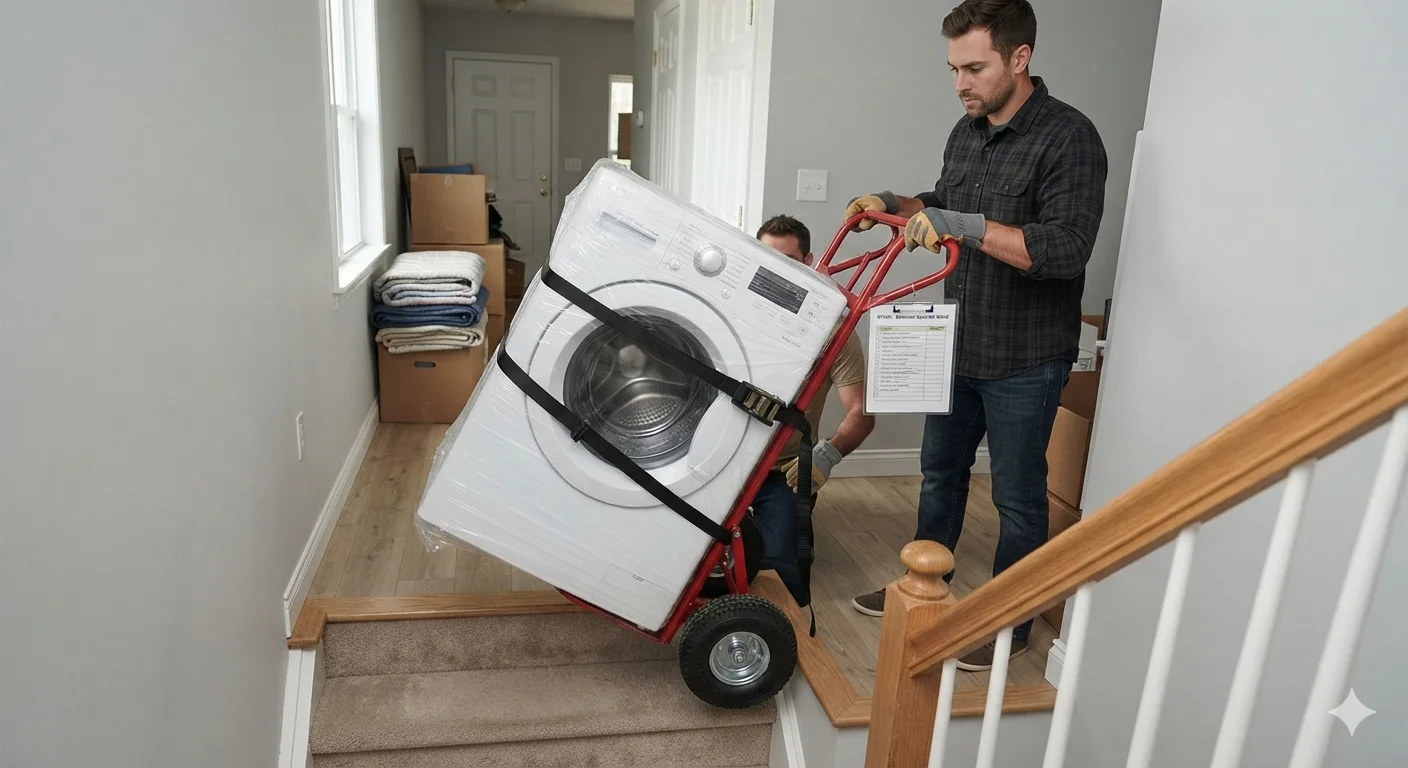
The straightforward answer to the question about moving a washing machine down the stairs would be as follows: Disconnect and drain the washing machine fully; if you have transit bolts, use them to hold the washing machine’s drum; strap the machine securely onto an appliance dolly and then walk it down with one person steering it from below and the other controlling its tilt from above. The washing machine is a heavy and front-heavy appliance that does not forgive any mistakes.
In case you’re moving on a budget and do not plan to hire professional movers, the following is the step-by-step explanation on how to do it safely.
Table Of Contents[hide]
Tools You'll Need
All of these are available from the local hardware store and a dolly can even be rented at a cheap price in case you do not have one.
- Appliance dolly, ideally a stair climbing dolly
- Heavy-duty moving straps
- Forearm forklift lifting straps
- Furniture blankets or moving pads
- Duct tape or packing tape
- Channel lock pliers or adjustable wrench
- Bucket
- Towels
- Safety gloves
- Steel-toed boots
- Permanent marker
From personal experience moving houses, a stair climbing dolly has proved to be more useful for this task than any other tool. With the steps in the wheels, the device rolls down from one stair to another in a controlled fashion as opposed to carrying the entire weight by two people throughout the descent.
Things to Check Before Moving Washing Machine Downstairs
Before disconnecting a single hose, you should spend a little time checking on a few basics. It is a step that is always forgotten and it is the reason why a washing machine move becomes dangerous on the stairs.
- Weight. The weight of a typical washing machine ranges from 150 to 200 pounds, with the front-loading machines being heavier due to the concrete counter weights. Ensure that you know the weight of your washing machine so that you estimate the number of people needed.
- Pathway. Go through the actual path right from the laundry room to the stairs. Look out for sharp turns and any obstruction in the way.
- Width of gate. Should you have to load a washing machine for transport outside a gated area, take note of the width of the gate opening compared to the width and depth of the washing machine.
Step-by-Step Guide to Moving Washing Machine Downstairs
- Step 1: Turn Off the Water Supply
Turn off the water shutoff valves behind the washer and close them fully. This prevents any water spillage once the inlet water lines are detached later.
Failing to do so has been an error made by homeowners that I have witnessed more than once; and inevitably ends up with much water spilling on the floor. In case you have no idea about where the water valves leading to the washer are located, turn off the water supply to the whole house temporarily.
- Step 2: Disconnect the Hoses and Power Cord
Unplug the power plug of the machine before using your adjustable pliers to remove the water inlet lines. You will need a bucket and towels as some water will still be draining from the inlet lines after turning off the water source.
Remove the drain line last to avoid dripping water on the floor but into your bucket instead. Coil the drain lines and power cable together and secure them in place with tape.
- Step 3: Drain the Drum Completely
Perform a short spin cycle in case there is electricity available; otherwise, tilt the machine manually and drain out any water left inside the drum in a bucket. Extra water in the drum affects the balance because of the extra weight that is unpredictable when moving on stairs, as the water moves inside the drum unpredictably.
- Step 4: Insert Transit Bolts if Available
It is more significant than one might think, because of the imbalance that happens due to the water in the drum when tilting. In case you have a small filter for draining at the bottom of the machine, check it as well, as they usually hold a lot of water.
Use transit bolts, if they are available, in order to fix the drum into the proper position. They are used to secure the drum not to swing inside during transportation, and they decrease the possibility of noises and the problem of the drum being tilted. If the original bolts are lost, universal transit bolt sets can be found in some hardware stores, or towels can be packed around the opening of the drum.
- Step 5: Wrap the Machine in Moving Blankets
Wrap the furniture blankets or moving pads around the machine to cover the control panel, detergent dispensing drawer, and any front load or top load doors or lids. Tape or tie down the blankets on the washing machine, ensuring that the leveling legs are still accessible.
Covering the control panel is essential at this point because these control panels are quite fragile and can easily break when they come into contact with walls or stair railings. One common error is wrapping the body of the washer but leaving the control panel uncovered.
- Step 6: Secure the Machine to the Dolly
The appliance should be slightly tilted back, and the base of the dolly should be slid under the machine. The machine needs to be tightly strapped onto the dolly with moving straps.
Loosely strapped washing machines is one of the major causes of dropped appliances during the moving process. It is vital to make sure that the straps are securely tightened in order to prevent the washer from moving in any way after it has been loaded.
- Step 7: Walk the Machine Down the Stairs
Under the control and guidance of the one individual below, and management of the tilt by the one above, walk the dolly down the stairs one at a time utilizing the stepping wheels on the dolly, if you have one that is capable of walking up stairs. Take things slow, communicate clearly between the two individuals and never hurry this step even if it seems that everything is going well.
Should the machine start to tilt outside of the parameters where it is safe to move forward, stop the process and reposition yourself instead of trying to muscle through this phase. Be sure to wear steel-toed boots and safety gloves during this phase as crushing fingers and dropping appliances are the most commonly seen injuries in situations like this.
Special Situations
Moving a Washing Machine Alone
This is not something that can be done solo if there are stairs involved. The heavy and top heavy nature of a washing machine makes this dangerous for anyone to navigate solo, as there will be no back up if things go awry. Should you not have a second set of hands available to help you out, it is entirely acceptable to wait until you do.
Moving a Washing Machine Down a Narrow or Curved Staircase
The narrowness of a staircase, as well as a curved staircase, will make it much harder since you will have less time to correct any imbalance and the dolly with steps can also get uneven placement on the curved stairs. You should slow down more than you normally would and think about the temporary removal of a part of a rail in case it blocks your way and can later be attached again. If you cannot imagine how the dolly can fit into a staircase, it is the time to seek assistance rather than push it inside.
Moving an Older or Damaged Washing Machine
The old machine, which has some problems, for example, wobbly drum or cracked housing, should be moved with additional caution since any possible structural weakness might become worse when the machine is being tilted and moved by the stairs. The machine, which has the risk of collapse when placed on its own base, definitely won’t withstand any rough stair movement.
Common Mistakes to Avoid
- Skip the water shutoff and cause flooding
- Move the machine without stopping the water supply
- Leave the control panel uncovered during moving
- Use the unsecured strap for attaching the dolly
- Do a stair move alone without an additional person
- Lay the machine on its side during the transport
- Not moving slowly down the stairs
Based on having helped many families move over the years, here are the mistakes that are common and that usually do not cost anything to avoid. Just a bit of extra effort and planning prior to moving day is all that is required.
When Professional Movers Can Help?
For some people, DIY washing machine moves are possible provided that there is a straight staircase, help from a friend, and appropriate equipment. However, there will be occasions where seeking assistance is preferable to stubbornly insisting on doing it yourself.
A narrow, curved or steep staircase, lack of a helpful second person, and a very heavy or old washing machine make professional help necessary because they have the proper tools and skills for the task.
Professional companies such as Power Movers perform appliance moves such as this on a regular basis thus saving householders from property damage, muscle or back injuries, and repair costs for drywall tears, railings broken during the move, or appliance damage.
If it is not possible for one to lift and control the heavy appliance on a staircase, this is a perfectly valid reason for getting assistance.
Conclusion
However, when it comes to transporting a washing machine down the stairs, everything depends on preparation and proper execution. This involves disconnecting and draining the device, securing the drum and strapping it securely onto a dolly. Following the above instructions, you will definitely save yourself from flooding, dents, and even injury that can become the outcome of such a tricky moving process.
Whatever method you choose to employ – moving down the stairs by yourself with a partner or hiring professionals, the objective is always the same: to get your washing machine where it needs to be. Are you ready to think through the moving process?

Article written by
Gary founded Power Movers in 2007 after watching too many moving companies damage or steal from customers with no consequences. The company runs on one rule: every crew member gets background-checked, trained, and held to the same standard Gary was held to as a police officer. Over 9 years in, Power Movers handles local and long-distance moves, specialty items, and corporate relocations for Houston businesses including Tesla and Airgas.