
How to Pack an Apartment for a Move: Room-by-Room Guide for Renters
Knowing how to pack an apartment for a move is a little different from packing a house. You have less space to spread out, stairs or elevators to deal with, building rules to follow, and a security deposit riding on how you leave the unit. The good news is that apartments are also smaller, so with a plan, the work goes faster than you might expect.
- Read your lease and call the leasing office first. Find out the notice you must give, move-out rules, and any elevator, parking, or insurance requirements.
- Declutter before you pack. Every item you don't move is one less box to carry down the stairs.
- Start with what you use least, and pack room by room. Leave the kitchen basics and bathroom for last.
- Use small boxes for heavy things and suitcases for books. Stairs and elevators punish overpacked boxes.
- Protect the building. Hallways, door frames, and floors are part of your deposit.
- Document the unit and give your forwarding address in writing. In Texas, that starts the clock on your deposit refund.
Table Of Contents[hide]
Steps to Move Apartment
Step 1: Check Your Lease and Building Rules
Before you buy boxes, spend 15 minutes on the paperwork and a phone call.
- Check your lease for move-out notice. Some leases require 30 or 60 days of written notice. According to Texas RioGrande Legal Aid, if your lease conditions your deposit refund on advance written notice, that requirement must be underlined or in bold print. Even if your lease doesn’t specify a time, it’s wise to give at least 30 days of written notice and keep a copy.
- Pay your last month’s rent. A security deposit is not last month’s rent. In Texas, withholding the last month’s rent can make a tenant liable for three times the unpaid amount plus the landlord’s attorney’s fees.
- Ask the leasing office for the move-out packet. Find out elevator reservation rules, allowed moving hours, loading dock or truck parking, floor and wall protection requirements, and whether a certificate of insurance is required.
- Reserve the elevator or loading area as soon as you know your date. Popular dates, especially the end of the month, book up quickly.
- Plan the same for your new building. Your new apartment may have its own move-in rules and reservations.
Items movers generally won't move
Step 2: Make a Timeline
As a rule of thumb, start 4 to 6 weeks out. A studio may take a day or two of steady packing, while larger apartments can take several days. Here’s a simple timeline:
When | What to do |
6 to 8 weeks out | Read your lease, give notice, start decluttering, and book movers or helpers. |
4 weeks out | Gather supplies, reserve the elevator or loading zone, and start packing seasonal items, books, and decor. |
2 weeks out | Pack most of your living areas. Request the certificate of insurance if your building requires one. Arrange donation or disposal. |
1 week out | Pack the kitchen and bedrooms, except for essentials. Confirm everything with your movers and building. |
1 to 2 days out | Pack bathrooms and essentials. Disassemble furniture. Charge devices. |
Moving day | Walk the unit with your movers, protect hallways, and load priority items last. |
After moving out | Clean, do your final walk-through, return keys, and give your forwarding address in writing. |
Step 3: Declutter First
The easiest box to carry down the stairs is the one you never pack. Go through your apartment room by room and sort items into keep, sell, donate, recycle, and trash. Ask whether you’ve used each item in the past year, whether it’s in good condition, and whether it will fit in your new space.
If you’re downsizing, measure your new apartment and decide which furniture will actually fit before you pay to move it.
Step 4: Gather Supplies
- Boxes in three sizes: small for books and heavy items, medium for general items, and large for light, bulky items
- Wardrobe boxes for hanging clothes
- Heavy-duty packing tape, a tape gun, and a box cutter
- Permanent markers and labels
- Packing paper and bubble wrap, plus towels and linens as padding
- Zip-top bags for screws, hardware, and cords
- Moving blankets and stretch wrap for furniture
- A hand truck or dolly, if you’re moving yourself
- Painter’s tape for labeling furniture and drawers without marking surfaces
- Suitcases, duffel bags, and laundry baskets you already own
Free boxes are available from many grocery stores, liquor stores, and bookstores. Choose clean, sturdy boxes, and skip any that are damp or have a strong odor.
Step 5: Pack in the Right Order
Start with what you use least and finish with what you use daily.
Order | What to pack | Why |
1 | Storage closets, balcony or patio items, spare room | You won’t miss them |
2 | Wall hangings, curtain rods, decor, books, out-of-season clothes | Decor is nonessential, and it’s often left until the last minute |
3 | Living room: media, shelves, extra furniture | Frees up space to work |
4 | Dining area and non-essential kitchen items | The kitchen takes the longest |
5 | Bedrooms and closets | Keep a few days of clothes out |
6 | Bathrooms and kitchen essentials | You’ll need them until the end |
Pack one room at a time and finish each one before starting the next. Label every box with the destination room and a short list of contents.
How to Pack an Apartment, Room by Room
Kitchen
The kitchen is usually the most time-consuming room because of its fragile items.
- Pack in this order: specialty gadgets, serving pieces, and china first, then everyday dishes and pots, then pantry items.
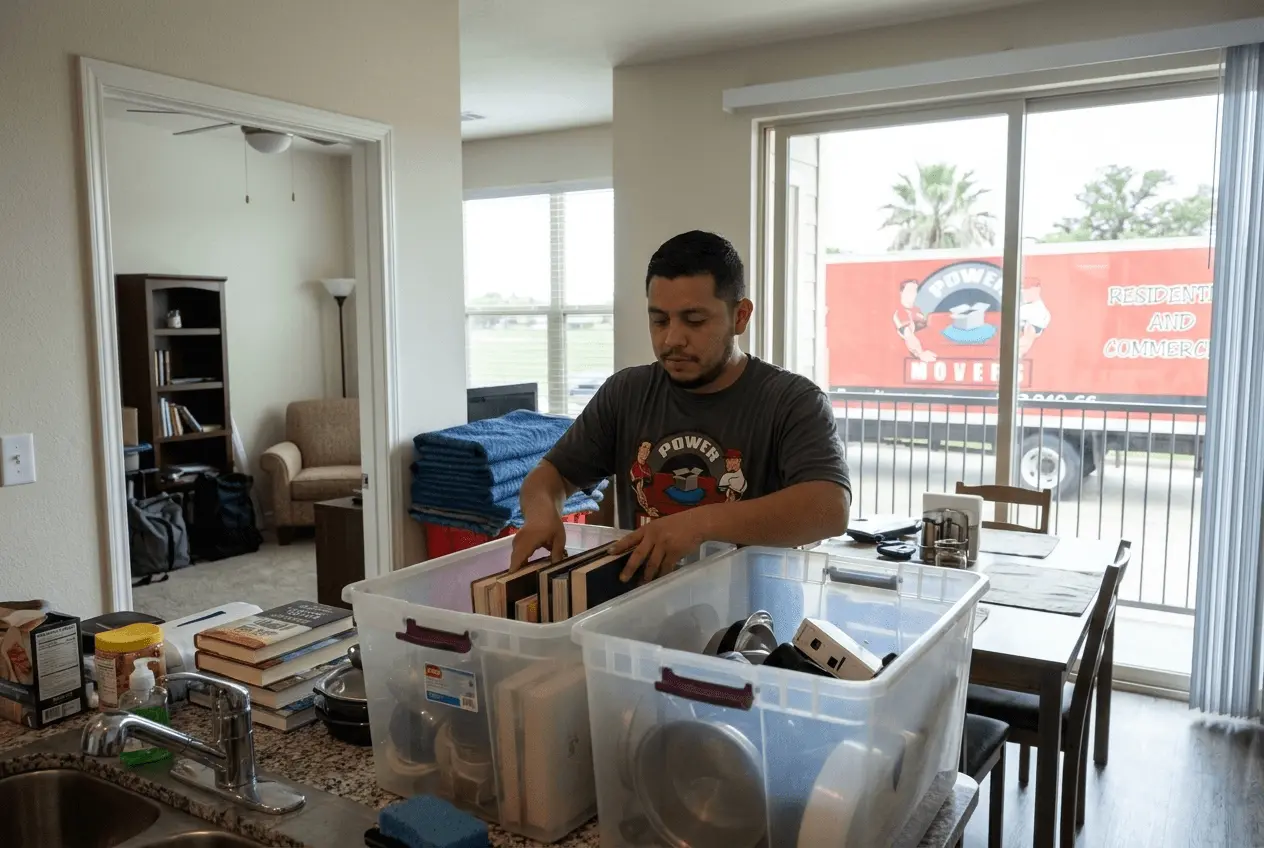
- Dishes: Wrap each piece individually, and pack plates on their sides like records, which makes them less likely to break. Use small or medium boxes for heavy items like pots, pans, and small appliances, and use towels to fill gaps.
- Glasses: Wrap each one, and place them upright in a box with dividers or crumpled paper.
- Pantry: Pack sealed, non-perishable items. Use up your fridge and freezer in the weeks before the move.
- Liquids: Seal them in zip-top bags, and put plastic wrap under the caps.
- Keep a day-one kitchen box: a couple of plates, cups, utensils, a pot, coffee supplies, paper towels, and cleaning supplies.
Living Room
- Photograph the back of your TV and electronics before unplugging them. Bag the cords and label them.
- Wrap screens and frames in blankets or padding, and pack them upright.
- Take books down early, and pack them in small boxes or suitcases so they don’t get too heavy.
- Pack decor, plants, and lamps with padding. Remove shades and bulbs.
- Wrap furniture: Remove legs from tables and sofas where possible, wrap pieces in moving blankets, and secure them with stretch wrap. Put hardware in a labeled bag, and tape it to the furniture or keep it in a single box.
Bedrooms and Closets
- Keep clothes on hangers and use wardrobe boxes, or fold clothing into boxes by weight. If your dresser is light, you can leave clothes inside and wrap the drawers shut with stretch wrap. Ask your movers.
- Disassemble the bed frame and bag the hardware. Wrap the headboard and mattress.
- Use towels, sheets, and sweaters as padding for fragile items.
- Pack shoes in small boxes, since they’re heavy.
- Keep out a few days of clothes, your bedding, and your toiletries.
Bathrooms
Pack these last. Seal all liquids in zip-top bags, group items in small bins, and keep medications and toiletries for the first few days in your essentials box.
Balcony, Patio, and Storage Closet
Check these early so you don’t forget them. Clean off outdoor furniture, drain planters, and disassemble grills. Don’t pack propane tanks, since movers generally won’t transport them.
Entryway and Closets
Pack seasonal coats, shoes, and bags early. Keep one or two coats and a pair of shoes accessible.
Moving-Day Logistics for Apartments
- Confirm your elevator or loading zone reservation a day or two before.
- Send the certificate of insurance to the leasing office if they require one. Many apartment buildings ask for a COI from your moving company before the crew starts. Give your movers the building's requirements well before moving day.
- Check parking. Make sure a truck can park near the entrance, and ask whether the building requires a permit or reserved space.
- Do a walk-through with your movers, and point out what's going and what's staying.
- Keep the path clear of pets, kids, and boxes.
- Load heavy and sturdy items first, and keep your essentials and valuables with you.
- Keep your essentials box in your own vehicle.
Packing an Apartment in Houston, TX
Beat the heat. Houston summers combine high temperatures with heavy humidity. In late July 2026, forecasters expected heat index values of 108 to 110°F in the Houston area. Breezeways, stairwells, parking lots, and balconies can be hotter than the air outside. OSHA and NIOSH advise drinking water every 15 minutes in hot conditions and taking frequent breaks in shade or air conditioning. Signs of heat exhaustion include weakness, wet skin, headache, dizziness, and nausea. Heat stroke, with confusion, fainting, or hot dry skin, is a medical emergency, so call 911. Houston stays warm and humid well into fall, so plan for the heat even in October and November.
Watch the humidity. Make sure clothes and linens are completely dry before packing, since damp items can develop mildew. Cardboard can soften in humid air or rain, so stage your boxes inside and keep them off wet balconies, patios, and parking lots.
Time your move. Early morning and evening are more comfortable for carrying boxes and furniture. Book early in summer, which is peak moving season, and around the end of the month, when many leases turn over.
Check your building’s rules. Houston high-rises, mid-rises, and garden-style complexes can all have different requirements. Ask your leasing office about elevator or dock reservations, moving hours, parking, and insurance paperwork.
Dispose of hazardous items properly. Don’t leave paint, chemicals, fuels, or aerosols by the dumpster. The City of Houston’s Environmental Service Centers accept household hazardous waste from residents. Call 311 or check the city’s website for hours and requirements.
Don’t dump bulk items. Ask your complex how it handles large items before leaving furniture by the dumpster, since rules and fees vary. You can also donate. Goodwill Houston, Houston Habitat for Humanity ReStores, and the Houston Furniture Bank accept household goods. Call first, because accepted items and pickup options vary, and schedule early.
Hurricane season. The Atlantic hurricane season runs through November 30. Check the forecast, and have a backup plan for your move date if a storm threatens the Gulf Coast.
Common Mistakes to Avoid
- Skipping your lease and building rules, then finding out you needed an elevator reservation or insurance certificate
- Packing before decluttering
- Overfilling boxes that have to go down stairs
- Leaving the kitchen and bedrooms to the last day
- Forgetting to check balcony, storage, and closet spaces
- Taping directly to walls or finished furniture
- Skipping photos of the unit after you clean
- Failing to give your forwarding address in writing
- Withholding last month’s rent and expecting your deposit to cover it
- Moving in the midday heat without water and breaks
Moving long distance from Houston, TX
If you’d rather not do it all yourself, we can help. Our packing and unpacking services can pack your apartment for you, and our packing supplies can get you started if you’re packing on your own. If you just need strong hands for loading and carrying, ask about moving labor. We also offer local moving, long-distance moving, and specialty moving for heavy or fragile items. We serve Houston, Spring, Katy, Sugar Land, and Cypress. If your building has elevator, parking, or insurance requirements, tell us early so we can plan around them.
Ready to plan your move? Call (832) 940-6683 or request a free quote.

Article written by
Gary Williams founded Power Movers, a Houston moving company with more than 1,000 reviews. He spent 12 years with the Houston Police Department’s Central Division, where moving-company complaint calls were part of what pushed him to start the business. Power Movers has worked with Tesla, Lululemon, and the Houston Rodeo, and is featured in Forbes Advisor’s Best Moving Companies in Houston list.