
How to Move a Dining Table by Yourself: A Safe, Step-by-Step Guide
Moving a dining table by yourself can save you the cost of a crew, if you do it right. It’s also one of the most awkward pieces of furniture in any home. The top is wide, flat, and heavy, the legs can loosen or crack at the joints, and the finish scratches the moment it brushes a doorframe. With some prep and a few inexpensive tools, one person can move many tables safely.
Here’s how to decide whether a solo move is realistic for your table, how to do it step by step if it is, and when to call a pro if it isn’t.
Table Of Contents[hide]
How to move a dining table by yourself?
- Take it apart. Pull the legs and any leaves so you're handling smaller, lighter pieces.
- Wrap every piece. Moving blanket first, stretch wrap over it. Keep tape off the finish.
- Slide or roll first, lift last. Furniture sliders, a blanket "sled," and a dolly carry the weight so you don't have to.
- Carry big tabletops on edge, close to your body. Never carry a glass or stone top flat.
- Know when to stop. Stairs, large glass tops, stone tops, antiques, and any top you can't lift at one corner call for two people or a pro.
Can you really move a dining table by yourself?
For many tables, yes. For some, no. The top is almost always what decides it.
A useful benchmark: NIOSH, the federal workplace-safety research agency, builds its lifting guidance around a 51-pound load constant. That’s the most it recommends lifting even in ideal conditions, meaning the load is close to your body, you’re not twisting, and it’s at a comfortable height. OSHA’s safe-lifting guidance, as summarized by the National Safety Council, says loads over about 50 pounds shouldn’t be lifted manually. A tabletop is nowhere near an ideal load. It’s wide, hard to grip, and you have to turn with it through doorways.
And tabletops get heavy. Product spec pages list a 60-inch round marble pedestal table at 385 pounds, and one marble top by itself at 183. Large solid-wood tops can run well over 100 pounds.
Try the corner test. Squat, grab one corner of the table, and lift it an inch or two. If it comes up easily and you don’t have to twist or brace against something, the top is probably manageable once the legs are off. If you struggle to tip up even one corner, don’t plan on carrying it alone.
Then check your table and route against this:
Your table and route | Solo move? |
Lightweight wood, veneer, or laminate top; legs unbolt; one level; wide doorways | Realistic with good prep |
Heavy solid-wood top, but a flat, straight route with no stairs | Possible with sliders, a dolly, and a ramp, plus a helper for the final lift into the truck |
Large glass top, any stone top, an antique or custom piece, stairs, tight turns, or a top you can’t lift at one corner | Get help |
What you'll need
Gather everything before you start so you’re not hunting for tape halfway through.
- Screwdriver, Allen wrench set, or socket set to match the hardware under your table
- Zip-top bags and a marker for bolts, washers, and brackets
- Moving blankets or furniture pads as the first layer on every piece
- Stretch wrap to hold blankets in place
- Foam or cardboard corner protectors for tabletop corners and edges
- Furniture sliders: felt-bottom for hardwood, laminate, and tile; hard plastic for carpet
- A furniture dolly, plus a panel-style dolly if you’re moving glass or stone
- Plywood sheets to give a dolly a smooth path over carpet
- A loading ramp if you’re putting the table in a truck, van, or trailer
- Ratchet or cam straps for tie-downs
- Work gloves and closed-toe shoes with good traction
- Tape measure, painter’s tape, and your phone for measuring, labeling, and photos
- Optional: forearm or shoulder lifting straps, used exactly as designed
Step 1: Measure the table and your route
Most damage happens when a table meets a doorway it doesn’t fit through. Measure first.
- Measure the table’s length, width, and height, plus the thickness of the top. Once you’ve planned how it comes apart, note the largest single piece you’ll be carrying.
- Measure every doorway, hallway, stairwell, and elevator on the route. For doors, measure the clear opening with the door fully open, and note how much room you’ll have behind it to pivot.
- Watch for ceiling fans, low light fixtures, wall decor, loose cords, and thresholds.
- Measure your vehicle’s cargo space too (more on that in the own-vehicle section below).
Step 2: Clear the path and prep the area
- Move rugs, chairs, boxes, and decor out of the route.
- Sweep or mop hard floors, then let them dry. Grit trapped under a slider or blanket can scratch hardwood.
- Prop doors open and keep kids and pets out of the way.
- Clear everything off the table, then wipe the top with a soft cloth to remove dust and crumbs that could scratch the finish under padding.
- Take photos of the table from several angles, especially underneath, so reassembly is easy.
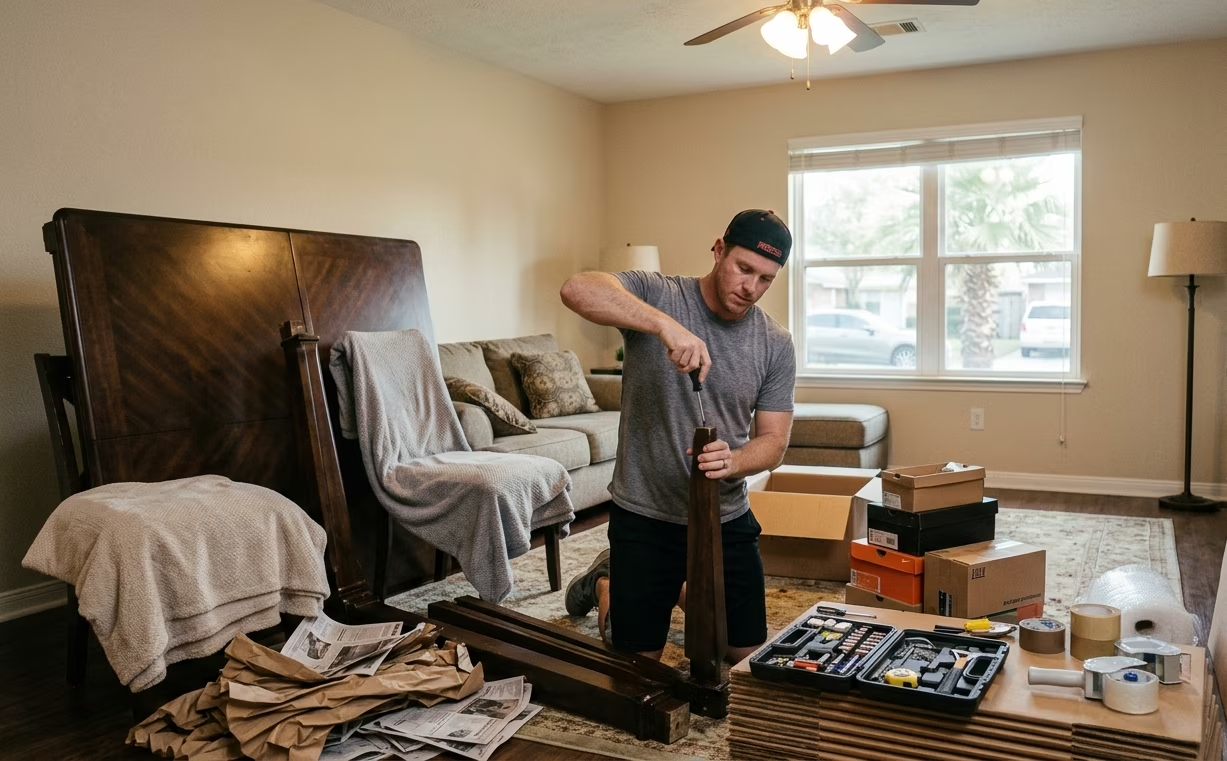
Step 3: Take the table apart
A smaller table is easier to carry and puts less stress on its joints. Look underneath before you pick up a tool, because tables come apart in different ways:
- Bolt-on legs. Many tables hold each leg with a hanger bolt through a corner bracket, tightened with a nut or wing nut. Take off the nut and the leg comes free.
- Legs on an apron. Some legs are held to the apron with brackets or screws. Back those out and the leg is free.
- Pedestal or trestle bases. These usually bolt to the underside of the top through a mounting plate. Take out the screws and lift the base away. The base alone can be heavy.
- Extension leaves. Pull out loose leaves and wrap them separately. With butterfly or self-storing leaves, figure out how the mechanism works before you take anything apart.
- Glued or fixed legs. If the legs are glued, doweled, or joined with mortise-and-tenon joints, don’t force them. A damaged joint is worse than moving the table assembled (see the fixed-leg section below).
Doing it alone:
- Lay a moving blanket on the floor.
- Ease the table onto a long edge on the blanket, or flip it upside down if it’s light enough to control. If you can’t control the tilt, stop. The table needs a second person.
- Hold each leg with your hand or knee as you loosen the last fastener, so its weight doesn’t pull on the top.
- Drop every bolt, washer, and bracket into a labeled bag right away. Don’t set them down “for a minute.”
Step 4: Wrap and protect every piece
Finished surfaces shouldn’t touch anything hard, or each other.
- Tabletop. Cover it with a clean moving blanket that hangs over all the edges. Put foam or cardboard protectors on the corners, because corners hit the doorframe first.
- Secure the padding, not the table. Run stretch wrap or tape around the blanket. Tape adhesive can lift veneer, leave residue, or damage a finish.
- Legs and base. Wrap each leg on its own, then bundle them. Pad carved details and joints.
- Leaves. Wrap each one separately. Never stack them bare against the tabletop or each other.
- Hardware. Attach the labeled bag to the wrapped bundle. Never attach it to the wood itself.
Tip for Houston: Use a breathable moving blanket as the base layer on wood. Plastic wrap pressed right against wood can trap moisture, and Houston’s humidity makes that a real problem.
Step 5: Move the pieces through your home
This is where solo moves succeed or fail. Slide or roll the load wherever you can, and lift only when you have to. When you do lift, use good technique.
- Sliders. Tilt a piece slightly and slip a slider under each leg or corner. Push with steady pressure. Don’t shove.
- Blanket “sled.” On hardwood, a wrapped tabletop with no legs can slide across a clean floor on a moving blanket. Think of it as a sled for flat-bottomed pieces.
- Dolly. Lay the padded tabletop flat on a four-wheel furniture dolly, center it, and strap it down. Push the dolly, don’t pull it. Use a ramp at thresholds rather than bumping over them, and lay plywood over carpet so the wheels don’t sink in.
- Carrying on edge. If you can lift a wood top comfortably, tilt it onto a long edge and carry it upright. That makes it narrower to handle and helps it fit through doors. First confirm that the top’s height, standing on edge, clears the doorframe.
- Lift with your legs, not your back. OSHA and NIOSH safe-lifting guidance agrees on the basics: keep the load close to your body, bend at the knees and hips, don’t reach or twist, and turn by moving your feet. Where you can, keep the load between shoulder and thigh height.
- Doorways and corners. Tilt the tabletop onto its edge to get through. If you need more clearance, take the door off its hinges. Go slowly. The edge usually hits first.
- Stairs. Don’t carry a full tabletop up or down stairs alone. It’s hard to control on a staircase, and sliders are no help there. Get a second person or a pro.
Step 6: Load the table into a vehicle
Hoisting a table into a truck is the riskiest moment of the whole move, so use equipment.
- Use a ramp or a lift gate instead of hoisting the table into a truck. If you can’t avoid a lift, get a helper.
- Stand the tabletop on its edge against a padded wall, on a cushioned layer, and strap it in. A wood top can stand on its long edge. Glass and stone stay upright too, with extra cushioning under the bottom edge.
- Load heavy pieces first, toward the front of the cargo area, and balance the load side to side. Keep a heavy base low.
- Don’t stack anything on the tabletop, even if it’s wrapped.
- Push-test the load. If you can shift a piece by hand, add a strap or pack the gap with padding.
- Pad your contact points. Don’t crank a strap over an unprotected edge.
Step 7: Unload and reassemble
- Clear the path at the new home before you bring anything in.
- Carry the pieces indoors, then take off the wrapping. Don’t leave a wrapped wood table sitting in a hot truck or humid garage any longer than you have to.
- Reattach the legs with the top lying on a blanket. Start each bolt by hand, then tighten them all evenly.
- Stand the table upright (get help if it’s a large one), check that it’s level and doesn’t wobble, and look the finish over for damage.
Moving different types of dining tables
- Wood and veneer: The risks are scratches, adhesive damage, and moisture. Blanket first, stretch wrap second, and a protector on every corner. Veneer edges are especially fragile.
- Glass tops: Glass cracks from a bump or from flexing. Pad it with soft cushioning, protect the edges and corners, and put rigid cardboard on both faces of a large top. Carry it and haul it upright on its edge, never flat. A large glass top is a two-person job.
- Marble, granite, and other stone: Stone is heavy and brittle. The Natural Stone Institute and WorkSafeBC both say never to lift or carry a stone slab flat. Handle it on end, in a vertical position. The Institute also advises that one person not manually lift items over 75 pounds. Stone tops are a get-help job, ideally with a panel dolly and a trained crew.
- Pedestal and round tables: If the top is designed to detach from the base, detach it. Carry the top on edge and move the base as its own piece.
- Extendable tables: Take out loose leaves, close the table fully, and label each leaf for reassembly. Never move a table with an extension half open.
- Tables with fixed legs: If the legs can't come off, the table moves assembled. Use sliders on hard floors, tilt it onto its side to get through doors, and plan on at least two people.
Moving a dining table in your own vehicle
A small, disassembled table can ride in an SUV or minivan. Larger tops need a pickup bed or cargo van. Whatever you use, pad everything, strap the load to the built-in tie-down points, and measure the cargo space before moving day.
If the load blocks your view or the hatch won’t close, use a bigger vehicle. Driving with an unsecured load or an open trunk can be dangerous and may break traffic laws. In a pickup bed, cover the load against the weather.
Moving a dining table in Houston
Plan around the heat. Houston summers pair high temperatures with heavy humidity. In late July 2026, forecasters expected heat index values of 108 to 110°F. Heavy lifting in that kind of heat raises the risk of heat exhaustion and heat stroke. Move the table early in the morning or in the evening, drink water the whole time, take breaks in shade or air conditioning, and learn the warning signs. Heat stroke is an emergency, so call 911. Houston stays warm and humid well into fall, so the same plan applies in October.
Protect wood from humidity. Wood expands and contracts, and humid air can cause warping, loose joints, or mildew. Use breathable blankets, don’t leave the table in a hot truck or an un-air-conditioned garage, and unwrap it indoors as soon as you arrive.
Watch the weather. Pop-up Gulf Coast showers are common, and hurricane season runs through November 30. Check the forecast, keep a waterproof cover handy, and go straight from door to vehicle.
Check your building’s rules. Many apartments, condos, and HOAs require advance notice, elevator or loading-dock reservations, set move-in hours, and sometimes fees or proof of insurance for movers. No matter where you live (a high-rise in Downtown or Midtown, a townhome, a house in Katy, Cypress, Spring, or Sugar Land), call your leasing office or property manager at least a week or two ahead. Otherwise you may be stuck with a table and no elevator.
Common mistakes to avoid
- Skipping measurements, then finding out at the door that the top won’t fit
- Taping directly to the table’s finish
- Carrying the table by its legs, which can loosen or break the joints
- Forcing legs or mechanisms that aren’t meant to come apart
- Losing the hardware
- Dragging the table across flooring without sliders or a blanket
- Carrying glass or stone tops flat
- Using the tabletop as a shelf in the truck
- Lifting more than you can control to save a few minutes
- Moving in the midday heat
When to Hire a Professional
- You can’t comfortably lift one corner of the top
- The table has a large glass top or any stone top
- The table is an antique, handmade, or expensive to replace
- The route includes stairs, tight turns, or a narrow elevator
- The legs are fixed and the table has to move fully assembled
- You’re short on time, help, or energy
A strained back or shoulder costs far more than a moving crew.
How Power Movers can help. We serve Houston, Spring, Katy, Sugar Land, and Cypress. If you only need muscle, our moving labor team can load, unload, and carry the heavy pieces. If the table has to come apart or go back together, ask about furniture assembly and disassembly. Heavy, fragile, or high-value tables go to our specialty movers, who have the equipment and experience for them. Our local furniture movers can handle the rest of your home, and you can pick up packing supplies if you’re doing the wrapping yourself.
Ready for a hand? Call (832) 940-6683 or request a free quote.
Frequently asked questions
Is it better to move a dining table with the legs on or off?
Off, if the table is designed to come apart. Without legs it’s lighter, easier to grip, and less likely to snag, and the joints take less stress. Don’t force legs that are glued or fixed.
How do I get a dining table through a narrow doorway?
Take the legs off, tilt the top onto its edge, and check that its height clears the doorframe. Still tight? Take the door off its hinges. Measure with the door fully open, and make sure you have room to pivot on the other side.
Can I move a heavy dining table by myself?
Only with equipment (sliders, a dolly, and a ramp) and a level, clear route. If you can’t lift one corner of the top, or you’d have to carry it up or down stairs, bring in a second person or a professional crew.
How do I move a glass dining table alone?
We don’t recommend it for large glass tops. If you have to, wrap the glass in soft padding, protect the edges and corners, put rigid cardboard on both faces, and keep it upright on its edge the whole time. A second person makes it much safer.
How do I move a dining table up or down stairs by myself?
Don’t. A full tabletop is hard to control on stairs, and sliders can’t help there. You need at least two people, or hire movers.
How do I protect a dining table from scratches?
Wipe the top clean, cover it with a moving blanket, add corner protectors, and hold the padding in place with stretch wrap or tape applied over the blanket only. Use sliders on floors, and never stack anything on the table.
Do I need to disassemble the table for a short local move?
Yes, if it’s designed to come apart. Even a short trip means doorways, corners, and braking, and a table with the legs on is easier to damage.
How much does it cost to hire movers for a dining table in Houston?
It depends on the table’s weight and material, stairs, distance, and crew size. For a real number, request a free quote from Power Movers and tell us about your table.
Before moving day
Take it apart, pad every surface, and let sliders and a dolly do the lifting. Check the weight and the route honestly, because sometimes the right call is a second pair of hands. If your table is heavy, glass, stone, or sentimental, Power Movers is a phone call away.
Sources used:
- NIH safety newsletter on the NIOSH lifting equation
- CDC Stacks, NIOSH lifting equation
- Safety+Health magazine, summarizing OSHA lifting guidance
- Texas A&M AgriLife, lifting techniques
- WorkSafeBC, stone slab handling
- Natural Stone Institute safety checklist
- KPRC Click2Houston, Houston heat safety
- University of Houston Emergency Management, heat tips
- Hunker, removing table legs
- Retailer spec pages for the table weights: Lulu & Georgia and EQ

Article written by
Gary founded Power Movers in 2007 after watching too many moving companies damage or steal from customers with no consequences. The company runs on one rule: every crew member gets background-checked, trained, and held to the same standard Gary was held to as a police officer. Over 9 years in, Power Movers handles local and long-distance moves, specialty items, and corporate relocations for Houston businesses including Tesla and Airgas.