
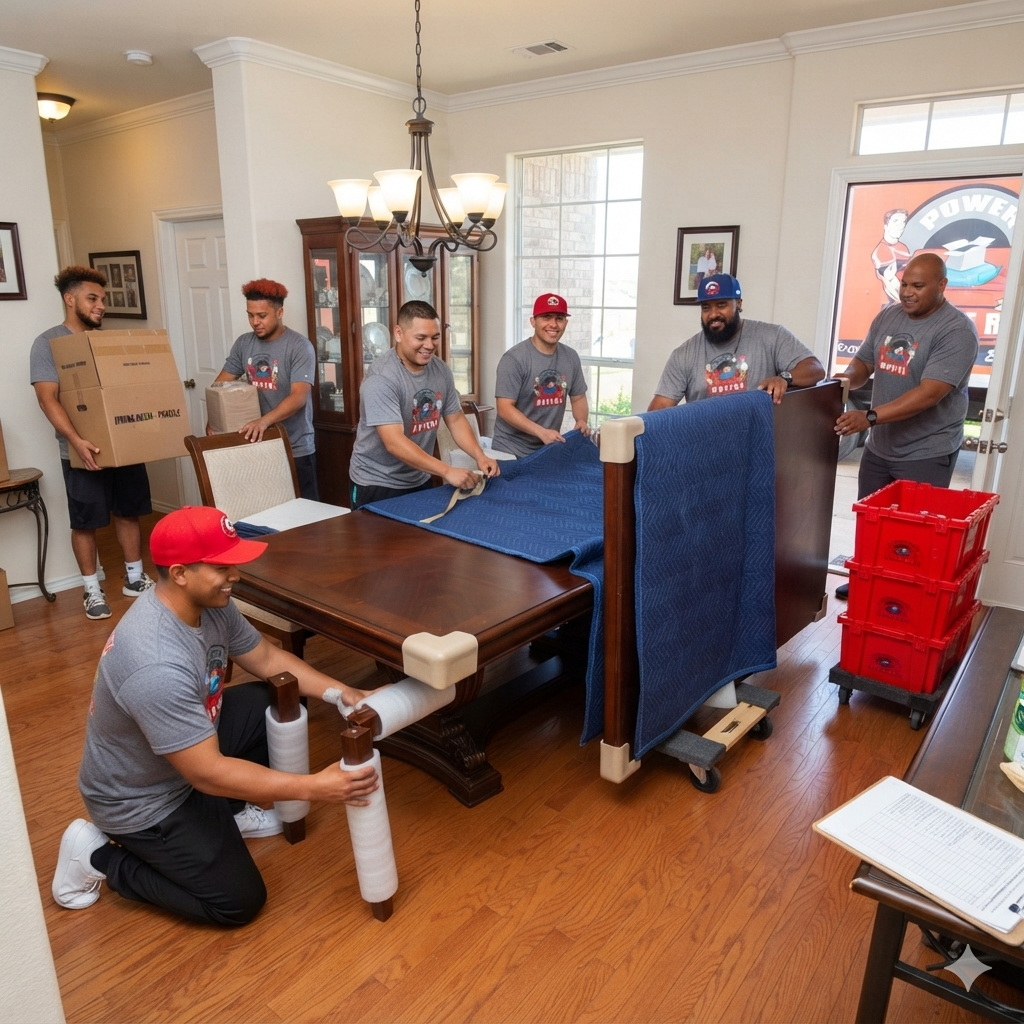
How to Move a Dining Table by Yourself Safely?
I’ll never forget helping a client move a dining table her grandfather had built by hand in the 1970s. She was terrified of scratching the finish or cracking a leg, and she’d nearly decided to leave it behind rather than risk it. I showed her how to wrap and move it that afternoon, and by the end she realized she could have done the whole thing herself with an hour of prep and one extra pair of hands.
If you’re wondering how to move a dining table by yourself without damaging the finish, denting a leg, or scraping up a doorway, you’re not alone.
It’s one of the most common worries I hear from people planning a move. In this guide, I’ll share the exact methods I’ve used to move dining tables safely for thousands of customers. By the end, you’ll know how to protect your table whether it’s solid wood, glass, or stone, whether you’re moving across town or across the country. Let’s start with the tools you’ll need.
Why Professional Dining Table Moving Matters (And Why DIY Is Possible)
Dining tables intimidate people more than almost any other piece of furniture, and it’s easy to see why.
They’re heavy, awkward to grip, and often finished with a surface that scratches if you drag it across carpet the wrong way. A solid wood dining table can cost $1,000 to $5,000, and a single deep scratch in the finish can hurt both its look and its resale value. None of that means moving one requires a professional.
It means it requires the right technique. The same logic applies whether you’re focused on this table specifically or trying to figure out how to move furniture by yourself in general: understand the piece, protect the finish, and don’t rush. Once you know where your table comes apart and how to wrap it, moving a dining table safely comes down to following steps in the right order, not brute strength.
Tools and Materials You’ll Need
Most of what you need is already in your garage, or available at a hardware store for a few dollars each. The goal with everything on this list is the same: keep the finish from touching anything hard, and keep the table from sliding, tipping, or racking while you move it. A few of these items double as protection for other furniture too, so it’s worth having them on hand for the rest of the move.
- Moving blankets or furniture pads – Protects the tabletop and legs from scratches and dings. $15-$30 per pair to buy, $3-$5 per pad to rent.
- Plastic furniture sliders – Lets you slide the table across floors without dragging or gouging them. $5-$10 for a set of four.
- Cardboard or plywood sheets – Creates a protective path under sliders on hardwood or tile. Free if you break down boxes, or $5-$10 for plywood.
- Rope or ratchet straps – Secures the table in the truck and keeps it from shifting. $10-$20.
- Packing paper or kraft paper – Wraps table legs and edges to prevent scuffing. $5-$10 per roll.
- Packing tape – Holds wrapping and blankets in place. $2-$5 per roll.
- Dolly or hand truck – Makes transporting a heavy tabletop or base far easier. $30-$50 to rent for a day, $100-$200 to buy.
- Furniture corner protectors – Cushions corners and edges from impact during loading. $5-$15.
- Permanent markers – Labels which side faces up and flags fragile parts. $1-$3.
- Measuring tape – Measures doorways, hallways, and the table itself before you commit to a route. $3-$5.
- Work gloves – Improves your grip and protects your hands from splinters or pinched fingers. $10-$15.
- Screwdriver or Allen wrench set – Removes bolts on tables with detachable legs or a pedestal base. $10-$20.
Most of these items cost under $75 total, and you can rent several instead of buying them. This small investment protects a piece of furniture that might otherwise be ruined by improper moving.
Preparation Steps Before Moving Your Dinig Table
Good prep is what separates a smooth dining table move from a stressful one. A few minutes of measuring and planning before you touch the table prevents most of the damage and delays that come from rushing straight into it. This is also where you figure out whether you’re dealing with a fixed base, removable legs, or a top that detaches from its base, since that changes how you’ll wrap and carry it.
- Measure the table’s length, width, and height and compare those numbers to doorways and hallways along your route.
- Identify where the table comes apart, whether that’s legs, a pedestal base, or removable leaves.
- Take detailed photos from multiple angles before you disassemble anything.
- Clear a work area with enough open floor space to wrap the table on all sides.
- Check the table’s finish, polyurethane, varnish, oil, or wax, since some finishes scratch more easily than others.
- Line up at least one helper for anything heavier than you can safely lift alone.
- Plan your exact route from the table’s current spot to the moving vehicle, including which doors you’ll use.
- Gather all your materials first so you’re not searching for tape mid-move.
This prep stage is where most DIY moves either go smoothly or fall apart. Skipping the measurements or the walkthrough feels like it saves time, but it’s usually what turns a one-hour move into a three-hour one. Professional movers build this assessment into every job automatically, which is part of why an experienced crew can move a full dining set faster than a first-timer can move just the table. Taking time to measure and plan first is the biggest factor in whether your table arrives without new scratches.
Understanding Your Dining Table Type
Moving to a new home should be exciting, not overwhelming. At Power Movers, we make residential moves seamless, stress-free, and surprisingly smooth. Whether you’re relocating across town or to a new neighborhood in Texas, our experienced team handles every detail with care and precision.
Fixed Dining Tables (Solid Base, No Removable Parts)
Fixed tables include pedestal bases, trestle bases, and standard four-leg designs that don’t come apart. In some ways, these are the easiest tables to move, since there’s no hardware to lose and no parts to keep track of. In other ways, they’re the hardest, since the entire table has to move as one solid, heavy piece.
The biggest risk with a fixed table is denting or scratching the base while angling it through a doorway. Wrap the base heavily, since it’s usually what makes contact with door frames and walls during the move.
- Find the maximum width of your table, often the center of the surface, and your narrowest door.
- Cover the entire base of your table with moving blankets, and focus on detailing the more fragile areas like the carvings or decor elements of the base.
- Individually wrap the tabletop, making sure all four edges and corners are covered twice at minimum.
- With your moving helper by your side, test the weight of your table with one slightly lifted edge; make sure you have a grasp of the weight you will need to carry and support.
- A typical error of individuals moving tables fixed at the base is to force their table through doorways on the sides rather than their backs (this can scratch the paint on the base or the wall, or crack a door jamb).
Dining Tables With Removable Leaves
The most frequent problems that occur in the moving of tables are the extensions leaves used on tables, not the overall size. Always inspect your table where the leaves insert before any other step. Loosen your table a couple inches to see how your extensions mechanism works.
- Open the table with whatever method your specific table extends (this will reveal how the extension works); after that, retrieve any and all leaves out of the table; keep your extensions leaves away from the table.
- Wrap all leaves in moving blankets as these parts of the table are often more delicate than the top; it is best to keep the leaves in the table protected when transporting.
- Close your table completely and slide the extension until it comes to a halt without a leaf in place; this proves that the table will be easier to reassemble.
- The next critical step that must be done for all table moves that involves the leaves on an extension table: label the extension leaves according to placement, such as 'leaf nearest the seat' (which often determines which side the chairs attach too).
- Customer's attempt to move their table with a leaf stuck half-way causes further difficulties and often more expensive repair; it is best to remember to keep all parts separate and intact when transporting your furniture.
Glass-top Tables
If you have a glass table, take precautions with transporting because even a crack can render the top unusable (since the damage cannot be sanded off as you could on wood). Most glass tables just sit on the base and do not attach, so there is more room for the glass top to slide around when you move it.
- Check if your glass top is a tempered piece (strong and difficult to break) or standard glass (easy to break).
- Wrap the table in moving blankets and use an additional sheet of bubble wrap all the way around the border of the top.
- Before handling, use painter's tape and place it in an X over the surface to help minimize shattering, in the unlikely event a crack occurs.
- With your helper, use careful, even motion and simply pick the glass top directly up off of the table base; try not to slide the top so as not to stress the edges.
- Hold the top upright while carrying, not horizontal, so as to avoid pressure on the middle of the top that might fracture the glass. You may consider moving the glass to an enclosed moving bin or lean it against a wall that is completely clear.
- Since most glass table tops are not attachable, these may require professional movers if it would ease your mind and simplify the moving process,especially if the table top is custom.
Tables for dinner with granite or a stone base
Granite table tops are known to be incredibly heavy and typically the single component weighs anywhere from 100 to 300 pounds which means you must plan on how to lift, carry, and support your stone table top, and have a couple of extra pairs of hands.
- Inspect your granite table top for any loose pieces or pre-existing cracks; do not attempt to move the stone top if it appears to be in less than perfect condition.
- You will not be able to lift the stone table top without at least 2 additional people regardless of how strong you might be; it is recommended to have at least 2-3 helpers to achieve a safe lift.
- Cover your stone top in moving blankets; tape all of the blanket securely all the way around the stone top, but avoid roping the granite, as a rope might add undue pressure onto the edge of the stone.
- As you or your helpers lift the stone, try your best to keep it perfectly leveled to prevent it from breaking or cracking under stress.
- As you lift and transport the stone table top keep the flat of the surface flat on a level plain as much as possible; do not tilt it at all during transport as this will undoubtedly cause cracks and possible shattering.
The challenges of moving a table that features a stone top can cause the do-it-yourself moving efforts to become overly stressful; for a guaranteed, safe, and damage-free move of your fine stone top furniture, hire the expertise and lifting equipment of professional moving services such as specialty moving company.
Step-by-Step Methods for Moving a Dining Table
To recap, what we’ve learned so far focuses on understanding the structure of your specific table, now the fun begins. I’m going to break down the method for how I move tables (most of them are fixed wood ones), and explain how each step contributes to a successful, scratch-free moving process for your entire home’s most utilized item of furniture.
For more delicate glass and stone table tops, use the guidelines previously explained before moving through the following steps. Let’s break it down.
The Complete DIY Method for Moving Your Dining Table
- First, remove everything from your table and do so efficiently, so nothing has a chance to fall during your preparations. Wipe down all of the surface, then the bottom as well (as if you’re preparing it for re-sale or refinishing), to eliminate any friction.
- Then measure your dining table from its longest points of the entire object of your furniture and ensure that these measures line up with all of the doorways, hallway access points, and truck entries/exits along the planned move-route you have for transporting the table. If the table dimensions do not line up, take time to determine the orientation that would enable it to fit through these points of restriction.
- Loosen or remove any components that may be easily detached – this could include decorative moldings or base supports – then cover and wrap individually with packing paper, and then apply moving blankets around the bundled piece.
- Place moving blankets over all edges and surfaces of the tabletop, wrapping around it multiple times for ultimate protection. Then secure the coverings with moving tape rather than taping the wood directly.
- In like fashion, cover your table's base or pedestal, being sure to provide additional attention to fragile elements that might have already loosened and need the protection from further movement.
- Utilize furniture sliders under each leg of your dining table's base. If you have a hardwood or tile floor that you are transporting across, place sheets of cardboard or plywood on top of the sliders, creating a track that provides an ultra smooth ride and protects both the table legs as well as the floor.
- With the help of your designated helper(s), cautiously begin to move your dining table toward the exit, both people keeping an eye on all areas to anticipate clearances and to warn the other should an approaching hazard become apparent, especially in the doorways.
- Upon arrival at the truck, carefully lower your dining table to a horizontal position where you will gently lift and carry the top of the table into the truck, allowing for maximum clearance.
- Place your tabletop securely into the interior of the truck, so as to not put pressure on a side of the tabletop facing any particular truck part.
If necessary, gently wrap rope or tie straps around the table, tightening them enough to keep it secure, yet not too much so that you compress the moving blankets too thoroughly; if you notice any shifts occurring during transport, readjust tie straps as needed to remove excessive friction/pressure from the tabletop.
Protecting Your Dining Table During Transport
Protecting your dining table during a move doesn’t stop once it’s wrapped and loaded. What happens during transport matters just as much as how carefully you packed it.
- Local moves (same town) — A short drive still needs the table secured; unsecured furniture can shift even over a few miles of stop-and-go traffic.
- Long-distance moves (across states) — Add extra padding at the corners and re-check straps at rest stops, since hours of highway vibration loosens things that felt tight at the start.
- Moving truck vs. rental van — A box truck gives you tie-down points and more room to brace the table; a van usually means wedging it against soft items instead.
- Weather considerations — Wood tables absorb humidity and temperature swings, so avoid leaving a wrapped table sitting in direct sun or a hot truck for hours.
- Stacking other items — Never stack anything on top of the table, even lightly, since minor weight can still dent a padded surface.
- Road conditions — Rougher routes need tighter securing and more cushioning at contact points, not just more straps.
A table that survives the move safely can still be damaged during transport if it shifts or items fall on it. This is where many DIY movers make expensive mistakes.
Common Mistakes to Avoid When Moving a Dining Table
After years of furniture moving, the following dining table moving mistakes are routinely observed.
Fortunately, these are easily avoidable with a bit of awareness. Dining with extensions still attached. Removable leaves or center pieces can be prone to sliding or getting jammed during the moving process.
- Inadequate protection: If the surface finish of the dining table directly contacts the blanket, padding, or the walls of the vehicle, scratches are likely to occur.
- Table is unsecured in the vehicle: An unanchored dining table can shift or topple in the vehicle, especially during hard braking or tight turns.
- Forcing a dining table through a doorway: Be sure to accurately measure both the doorway and the table dimensions, including any extended sections, to prevent scratching.
- Dining tables are not meant to be moved by one person. A two-person minimum is recommended for any dining table exceeding 100-150 pounds.
- Heavy objects stacked on the table: Any items placed on the table during the move, regardless of how lightweight, can leave dents or scratch the padded surface under stress and vibration.
- Not protecting the floor: If the furniture is dragged or slid across hard flooring, you can risk damage to both the floor and the dining table itself.
- Not inspecting after delivery: Unload the furniture from the vehicle first before beginning the unpacking process so you can properly inspect for any shipping damage immediately.
- Broken or unreliable tie-down ropes and straps: Worn straps and old ropes are more likely to snap under pressure, putting your dining table at significant risk.
These are normal mistakes and can happen to anyone moving their dining furniture. Many moving services provide services to take the risk out of such scenarios for valuable or sentimentally important tables.
When to Call the Professionals for Your Dining Table
Not everyone has the strength, expertise, or confidence to tackle the challenge of moving a dining table on their own, and that’s perfectly OK. The following scenarios are good indicators that hiring professional movers is a wise decision.
- Your table weighs more than 150 pounds on its own.
- You are moving an expensive, antique, or handcrafted dining table.
- You are moving a glass or stone-top dining table that would be very difficult to replace.
- You need to navigate tight spaces, such as stairs, narrow hallways, or multiple landings, with the table.
- You do not have sufficient help or physical capacity to lift the table safely.
- You are moving to a different state, increasing the amount of time spent in transit and raising the risk of damage.
- The moving weather is poor or road conditions are difficult.
- You are moving a custom-made dining table with unusual dimensions or intricate details.
Professional movers are equipped with the right tools, experience, and insurance to ensure your dining table is safely transported to your new home without damage. While some people are perfectly capable of moving their own furniture, others would benefit from entrusting the task to the experts.
Preparing Your Dining Table at the New Location
As the dining table has been moved to the new home, you should unpack, assess it for any damage, and set it up as it would ideally stand in the dining room, ensuring each piece is secure and properly aligned to the best of your ability.
- As soon as you unwrap the table, immediately examine it thoroughly.
- If damage occurred, addressing it directly after unpacking allows for swift and effective resolution, particularly if a claim needs to be filed with the shipping carrier or movers.
- After setting it up and inspecting, be sure to ensure the table’s top is flat and adjust it by leveling the legs to eliminate wobbling; this process also aids in preventing long-term stress or misalignment.
- Clean and polish it once it is in place, ensuring that your table looks its best.
Final Notes and Tips for a Seamless Dining Table Move
Your approach to moving your dining table will depend largely on its size, design, and how it deconstructs-whether it has removable legs, a glass top, or extension leaves that need special handling. If your table has extensions, carefully separate them from the main tabletop and wrap each piece individually, ensuring you label them if they’re not intuitive to reassemble.
Be patient and generous with your time, particularly with the wrapping and padding, and don’t rush when moving it through doorways.
If you find yourself getting overwhelmed by the weight of the table or the complexity of the move, it’s always acceptable to reassess and seek professional help; there’s no shame in acknowledging that a particular move is beyond your capabilities.
By following these guidelines and planning thoughtfully, you can significantly increase your chances of your dining table arriving at your new home safe, sound, and ready for years of use.