
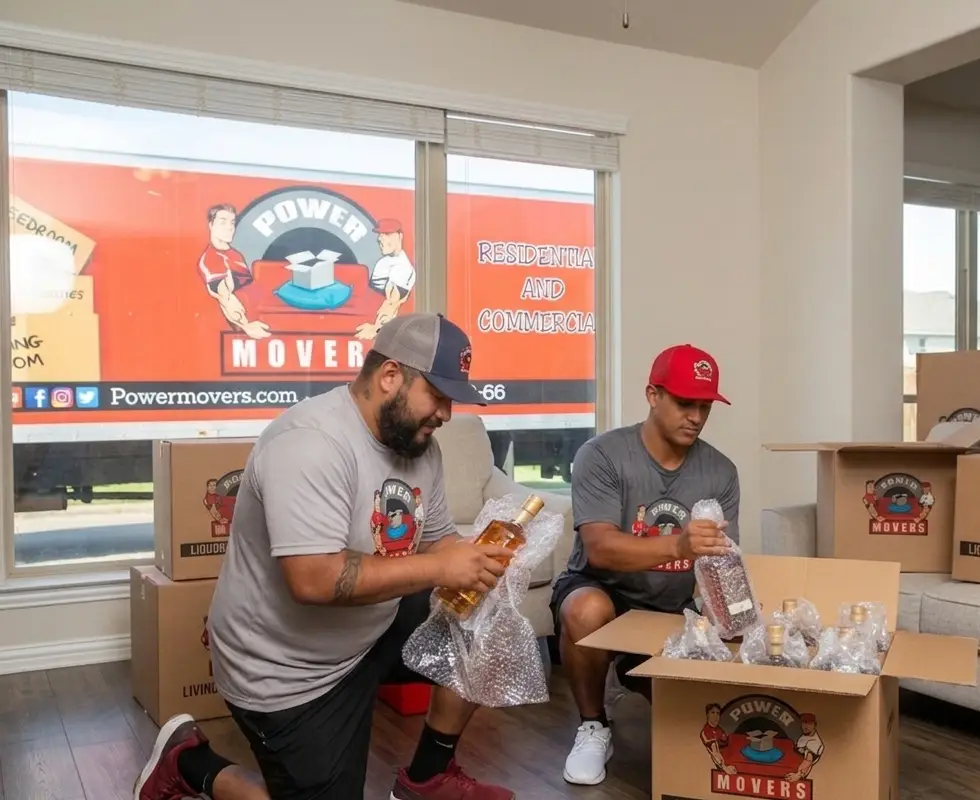
How to Pack Liquor Bottles for Moving Without Breaking?
One time I packed up a home bar for a client who had 15 years invested in building a collection of whiskey and wine, with bottles ranging in value from $200 to $500 apiece. She was utterly panicked about the possibility of a single jostle in the moving truck shattering one of her prize acquisitions and had almost considered ditching the whole collection to avoid the risk. By the end of that afternoon, I had shown her how to pack and box it, and every single bottle arrived at her new home without a single chip or leak.
If you’re currently asking yourself how to pack liquor bottles for moving without any breaks or leaks, know that this concern is completely justified. Broken glass is, in and of itself, unpleasant. A leaking bottle, however, can cause damage to every other bottle it is packed with.
In the following paragraphs, I am going to break down the exact methods I’ve personally used to pack countless bottles, tens of thousands to be exact, without breakage. At the conclusion of this article, you will be knowledgeable about how to securely prepare any wine bottles, spirits, and special occasion bottles for either a local or cross-country move. To begin, let’s list the required tools.
Table Of Contents[hide]
Why Properly Packing Liquor Bottles Is Important?
There are two significant consequences of packing liquor bottles improperly. The more obvious result of inadequate packaging for these types of bottles is shattered glass. What often slips the minds of DIY movers is the latter of these; any leakage from a bottle in transit will soak through the packaging and contaminate anything stored in close proximity to it.
A single, specialty liquor bottle can easily run between $100 to $500 or more; Some collectible bottles may have a value far greater than this. When a bottle breaks, not only are you suffering a financial loss but, should the bottle in question be a collectible or discontinued vintage, you also suffer the loss of something irreplaceable.
Fortunately, there’s no need for you to seek the assistance of a professional packer. You do, however, need a methodology! The best way to successfully pack any type of glass bottles for a move is a function of cushioning, separation, and weight distribution rather than specific training.
Tools and Supplies You Need for Packing Liquor Bottles
Thankfully, packing wine and spirits safely requires none of your typical professional-grade equipment or a trip to specialty supplier. You likely already have many of these supplies in your household, but if not, you may purchase a few dollars each from a grocery store, liquor shop, or hardware store.
The underlying goal of each material on this list is to prevent one piece of glass from making contact with another, and if breakage does occur, contain the spills to a minimal area. Keep in mind, a number of these materials can serve multiple purposes for your entire move.
- Wine Bottle Divider Boxes or Cardboard Inserts: To Prevent bottles from clinking together and breaking during the moving process. These can be purchased for as little as $10-$20 for 12-bottle dividers, or created from cardboard.
- Bubble Wrap: For added protection and cushion. $8-$15 per roll.
- Packing Paper or Kraft Paper: A protective sheet placed under bubble wrap to prevent scratches. $5-$10 per roll.
- Packing Tape: For sealing the box and securing wraps. $2-$5 per roll.
- Towels and Old Rags: For padding empty spaces when packing paper isn’t readily available. Use any you have.
- Newspaper or Blank Newsprint: To fill empty space and prevent bottle shifting. Free if saved up, or $8-$10 for a bundle.
- Sturdy Cardboard Boxes rated for Weight: These are to avoid boxes collapsing under 30-40 pounds of glass. Obtain from liquor stores for free, or $1-$2 apiece.
- Packing Peanuts or Foam Sheets: Extra cushioning around highly valuable items. $5-$10 a bag.
- Plastic Wrap or Shrink Wrap: to prevent leakage from cracked bottles. $3-$7.
- Permanent Markers: To label boxes "Fragile," "This Side Up," and "Liquids." $1-$3.
- Measuring Tape: To ensure your bottles fit into the boxes properly. $3-$5. Work Gloves-For improved grip. $5-$10.
- Box Cutter: To easily open boxes at your new home. $5-$8.
For less than $60, you can purchase all these materials for packing your liquors. You probably already have some items on hand!
Step-by-Step Preparation for Moving Liquor Bottle
Most of the catastrophes I’ve witnessed in my years of packing can be easily prevented by taking the time to prepare. Taking the time to inspect each item prior to any wrapping can save you from packaging a compromised bottle and even prevent damage to other valuable items. This process is also when you’ll determine how many boxes you actually need, based on the sheer volume of bottles you are relocating and their overall weight.
- Take inventory of your liquor collection and designate which items are the most valuable or would be the hardest to replace.
- Verify the seal on each bottle and screw down all caps securely; make certain corks are snug.
- Set aside any items that may be leaking or appear compromised in order to handle them at another time.
- Clean bottles so that grime is not transferred to your wrapping materials.
- Group bottles according to type; wine, spirits, and liqueurs so you don’t mix items with varying contents.
- Use only heavy-duty boxes which are rated to accommodate a load of up to 40 pounds of glass.
- Prepare a dedicated workspace where you will have sufficient room to wrap your bottles and stage boxes.
- Ensure you have all of your packing supplies within reach prior to starting the process.
- Based on the total number of bottles you possess and their various sizes, plan your layout of what boxes fit what size items.
Many amateur movers fall into the pitfall of forgoing the prep stage and diving right into the wrapping process. Doing this results in the overlooking of essential decisions that can, and will, prevent damage to your cherished liquids. Professional packers routinely include this sort of prep work in every single job.
This, along with their ability to check seals and isolate valuable items, can enable them to pack a bar cart full of liquids much faster and with far fewer loss incidents than an inexperienced individual. Ten minutes of this work can be the deciding factor as to whether your precious bottles arrive intact at their new destination!
Factors in Packing Liquor Bottle Types and Associated risks
Each type of bottle you are relocating does not carry the same level of risk as another. While your average 750ml wine bottle is pretty durable after being packed with proper padding and stored upright, a champagne bottle with pressure in it poses significantly greater risk; likewise, your $40 vodka does not need the same degree of precautions as a $300 bottle of premium scotch.
Before we look at the complete packing procedure further down, let’s get a general understanding of how to protect your different types of bottles from the risks each carries:
Wine Bottles (Standard 750ml Glass Bottles)
Packing wine bottles for the move is probably the first thing that comes to mind for most people moving a substantial amount of alcohol, and fortunately, these are some of the easiest types to move. A typical 750ml bottle can weighs up to 3 pounds with its contents, and the glass itself is strong enough to withstand a mild bump or two provided they are wrapped and secured to prevent impact.
- Stand up each bottle on one side and cover it with one sheet of packing paper followed by bubble wrap on the top.
- Wrap an extra layer of bubble wrap around the cork and the bottle neck – as it’s the most exposed area and vulnerable.
- Seal the wrap by taping it over itself – NEVER directly onto the bottle or the label.
- Put the wrapped bottles into a divider box, standing upright, with each bottle in its separate slot.
- Fill up all remaining spaces with crumpled paper so the bottles can’t move around in transit.
From experience, I have found that most people can pack wine successfully if they observe a couple of cardinal rules regarding separation and protection. Many skip the divider and just let the bottles lay against each other and this is where they chip or break in a bumpy drive.
Spirits Bottles (Whiskey, Vodka, Gin, Rum)
The real challenge of packing spirits involves tricky shapes and varying quality seals since spirits come in all shapes and sizes. They range from tall, slender bottles like vodka to short, fat ones like some whiskies, decanters included. The bottle may be thick, the glass strong but the seal might be weaker than the cork seal you’ll find on a wine bottle. Hence, check all caps before wrapping them up.
- Check the cap or cork for tightness as they might leak even if they are not broken.
- If bottles have square or flask like shapes, ensure you wrap more around the edges and corners of the bottle as that is where breakage happens most.
- Use generous amounts of bubble wrap for bottles that have broad bases or weird shapes as they are often difficult to fit in a regular slot.
- Stand them upright in the box, group similar shaped bottles together.
- Fill all spaces with crumpled paper around unusual shaped bottles as they may leave much bigger spaces than regular wine bottles.
A strong glass does not necessarily mean unbreakable. In most cases, it’s the awkward shape that gets stuck in a dividing slot and causes breakage, no one expected it.
Specialty and High-Value Bottles (Rare, Antique, Collectible)
For antique, rare and collectable bottles, your goal will not just be preventing them from breaking. It will be more to preserve their condition and sometimes, to retain their value.
- Take pictures of all high-value bottles – both sides and the label, front and back, even a photograph of wear or imperfections if you see any – before you wrap them, for the purposes of documentation and insurance.
- Use at least three layers of bubble wrap on all bottles, and a fourth for exceptionally valuable items.
- Pack rare and antique bottles separately in a smaller box – not in with the general items.
- Line the bottom and sides of the box with one inch of bubble wrap or packing paper, no less, on every side.
- Label the box distinctly as “HIGH-VALUE” or “IRREPLACEABLE ITEMS,” along with your general fragile stickers.
- Consider a policy of insurance with declaration of value for any bottle valued above several hundred dollars, particularly for a move that covers a long distance.
If you possess several antique bottles of rare vintages whose value is greater than 50-100 dollars each, it might be worth your consideration whether hiring professional moving services will provide more protection and value. Power Movers offer specialized moving services including a variety of packaging options perfectly suited for high-value items like those.
Craft Beer, Champagne, and Specialty Bottles
Carbonated beverages add one problem that wines and spirits do not. When moved around, the corks on a champagne bottle or those on a beer bottle could potentially be damaged or jostled causing pressure buildup and potentially opening, creating damage.
- Make sure that your champagne corks and their cages are fully secured before you pack, so that they are unable to escape.
- You may use the same methods you would for wine in packing beer bottles, wrapping each bottle first in paper then bubble wrap. Be sure you also wrap the top portion.
- Avoid storing your bottles of beer and Champagne in warm areas in the moving truck as heat may cause them to expand and leak.
- It’s best if possible to transport champagne upright as their corks tend to fall out, and it’s also better for beer bottles to travel upright as that makes the beverage easier to serve later without too much disturbance of the sediment.
- Don’t open your carbonated bottles for at least one day after you arrive at your destination.
The effect of carbonation makes the Champagne bottles and the beer bottles no different than your most precious wines and the stakes can be even higher.
Step-by-Step Methods for Packing Liquor Bottles
The information above has been focused on categorizing the bottle you want to pack, Now I’ll walk you through one, single, comprehensive method for packing liquor bottles together in a mixed box. For rare bottles and those that contain carbonation, combine this process with the advice already presented. This process has been used to move thousands of bottles without damage, whether they are wine bottles for my household or liquor from an entire home bar.
- Weight your move - boxes over 50 lbs are far more likely to be dropped and therefore cause breaks.
- Build dividers in the box – using card board strips or rolls of newspaper placed 2 to 3 inches apart will keep bottles separate.
- Wrap each bottle with two to three sheets of bubble wrap - start at the bottom and work your way up to the top, then work backwards down the neck.
- Seal wrap around the bottle by taping it on itself, never directly on the bottle. On wine bottles specifically, an extra layer of bubble wrap must go around the neck of the bottle as it is the most vulnerable part.
- Place two inches of packing paper or bubble wrap on the bottom of the box prior to putting bottles inside.
- Put all bottles upright –never put them on their sides in a shared box.
- Place the bottles into the individual compartments without touching the box itself. Pack in the empty spaces with rolled up newspaper or packing peanuts.
- When you put two rows of bottles in a box, put a piece of cardboard between each layer of bottles. The second layer of bottles is then wrapped according to these instructions from step 3 and gap filled from step 9.
- Wrap the second layer in a piece of plastic wrap before closing the box so any leaks will stay inside the box if it happens. Tape up all seams with your packing tape – double down on the bottom edges of the box.
Label box “FRAGILE,” “THIS SIDE UP,” and “LIQUIDS” on both sides.
Every item listed above addresses how a box is compromised during a move. If you cushion your items, your items will resist breakage. If you create dividers, your bottles won’t bang together. If you position items correctly, they will be stronger.
I have worked in the moving industry for over ten years and bottle cushioning and proper box support are two most important factors in getting items to their destination safely. I helped a customer pack their liquor collection which survived an accident in the moving truck because the boxes were packed well in this method.
Special Considerations for Different Bottle Sizes and Quantities
Protecting bottles during relocation comes down to two things: cushioning and weight management, and both change depending on how many bottles you’re moving.
- Small collections (under 12 bottles) — Fit in a regular moving box; repurposed wine boxes from a liquor store work well here.
- Medium collections (12 to 24 bottles) — Use divider boxes built for 12 bottles, and pack no more than two boxes stacked per carton for weight distribution.
- Large collections (25 or more bottles) — Consider professional packing services, since the risk of breakage and the physical weight both increase significantly at this scale.
- Mixed bottle sizes — Separate by size, and never mix oversized bottles with standard wine bottles in the same compartment.
- Fragile or valuable bottles — Use maximum cushioning, and consider individual boxes for anything worth more than $200.
- Temperature-sensitive bottles — Alcohol reacts poorly to temperature extremes, so keep boxes away from truck vents and out of direct heat or cold.
A single box of 12 bottles of wine weighs approximately 30 to 40 pounds. This is manageable for DIY movers, but if your collection exceeds 50 bottles, professional help becomes a practical consideration.
Transportation and Loading Best Practices
Transporting and loading these bottles is as vital as packing them securely.
- Place the liquor boxes on the flattest portion of the moving truck. These should be packed on the moving vehicle last so they're the first item you unload.
- Strap or tie the bottle boxes down securely using rope or moving straps so they do not shift during the move.
- Avoid placing bottles in direct sunlight or areas with high heat within your vehicle. Heavier objects can be packed around bottle boxes to keep them stable but should not be stacked directly on them.
- If driving over rough terrain, drive slowly. Also, avoid hard acceleration or braking, which will cause unnecessary jolting.
- On long distance moves (more than eight hours driving) check the bottle straps halfway to your destination if possible.
The most crucial part to a safe delivery is how you load your bottled contents on the truck and secure them so they do not move around while transporting them. A perfectly wrapped bottle may break if it is not loaded and secured properly in the moving vehicle.
Avoid These Common Bottling Mistakes!
I’ve packed thousands of bottles during my moving career, and these common packing mistakes seem to persist no matter how often I see them. Easily avoidable if you just know they’re mistakes!
- Boxes are too large: If bottles are rattling around inside your box, they are going to clink and crack the glass. Use appropriately sized box!
- Don’t pack bottles on their sides: Leaning or stacking your wine on its side createsuneven pressure on the cork and glass, increasing risk of breakage. Pack vertically, up-right.
- Skimping on cushioning to save money: You are probably not saving as much money as you think by just using a layer of newspaper, and you are much more likely to wind up with shattered bottles when it comes time to unpack.
- No dividers between bottles: Even with the extra room in your box, you will want to make sure that your liquor bottles don’t directly touch one another, and dividers help keep this safe and sound during the journey.
- Heavy items packed with delicate bottles: While it is true that you’ll want heavier items surrounding bottle boxes for stability, you should make certain that no heavier bottle is placed directly atop a delicate one.
- Do not verify your bottle caps are tight: While packing is critical, it is vital to ensure that your caps are tightly fastened because even a small gap will lead to significant leakage.
- Overpacking box weight limits: If you make your bottle boxes too heavy they are more likely to be dropped, break, or split at the seams.
- Packing items on top of bottle boxes: Never put anything on top of the box with your liquor – not even if it is light weight! The weight may press on a glass surface.
- Forgetting to mark boxes “Fragile”: This may seem obvious but it’s common, and when nobody marks the box, people are likely to stack other items on top, breaking it in the process.
These aren’t errors, per se, but learning opportunities. Even if you’re doing a bit of a learning curve with these lessons in your own move, keep them in mind when considering if you need a moving company specializing in fragile items to help with your collection. For example, our packing services for a liquor collection ensure that only professional-grade materials are used.
Who Needs to Hire Professional Movers to Transport liquor?
Although most people may opt to move their liquor collection on their own, some situations warrant professional help. Here’s when it makes sense to get help with moving your precious liquors:
- When your liquor collection exceeds fifty bottles.
- If your liquor is valuable and worth $50 to $100 or more per bottle.
- If you are moving 8 hours or longer away.
- Moving any vintage or antique bottles that are either impossible or incredibly difficult to replace.
- You do not have access to a reliable way to safely load and secure liquor boxes in your vehicle.
- The climate where you are moving is extremely hot, cold, or has unstable weather conditions.
- You are transporting an assorted selection of liquors, like mixed wine, spirits and other special bottles, altogether.
You have ran out of packing supplies, and time is short before your move.
The right mover comes with the best equipment, training and insurance to safely move all your precious items, from the most common wine bottles to unique spirits collections. There’s no right or wrong way to move your liquors.
Moving and Unpacking Your Liquor Collection
Like packing your liquor, unloading and unpacking require special attention, especially if you’ve taken a longer or bumpier route than planned.
- The bottle boxes should be the very first item to be removed from the truck, then place them immediately into a space with controlled temperatures.
- Allow 24 hours of rest for any bottles after an extended trip and rougher roads.
- Unwrap bottles slowly and carefully and then check the entire glass bottle surface for cracks or chips and look at the cap for signs of leakage.
- Wipe the bottle exterior, if it’s been accumulating dust, to remove it.
- Store bottles accordingly: room temperature is generally ideal for spirits while wine and Champagne require a cool, dark storage space.
When you’re ready to put your collection back on display or in its wine cellar, it’s important that you unload and unpack your items correctly, so you’re alerted to potential damage quickly.
Final Thoughts
Packing your liquor collection does not have to be a stressful ordeal; you just have to have the proper supplies and plenty of patience! While packing your liquor is a rather simplistic task, make sure to budget your time carefully. Do not go into it thinking it should only take you a little bit of time, and make sure that you are packing all of your bottles in an adequate manner, especially if your collection is of higher value, large, and you may not have much time prior to your move date.
I promise that your first experience ofPacking Liquor Collection Will take much longer than you originally assumed! That is all right; you should also give yourself a lot more time than you believe necessary in order to account for this task of collecting.
In the event you’re having trouble at this juncture of your moving and feel the burden is simply too great considering your specific collections’ size, value, timeline, or some combination thereof then that is perfectly acceptable to seek help. After all, we are not all able to complete every task required to pack such collection in our own. However if all this information looks straightforward for you and your collection you have certainly got the advantage.
When your liquor bottles have been perfectly packed, all that remains to be done is successfully transport and unpack them and the collection is ready to enjoy. Good luck and cheers! So, knowing these best practices and considerations for packing liquor bottles, which option feels like the best fit for your situation and upcoming relocation?

Article written by
Gary founded Power Movers in 2007 after watching too many moving companies damage or steal from customers with no consequences. The company runs on one rule: every crew member gets background-checked, trained, and held to the same standard Gary was held to as a police officer. Over 9 years in, Power Movers handles local and long-distance moves, specialty items, and corporate relocations for Houston businesses including Tesla and Airgas.