
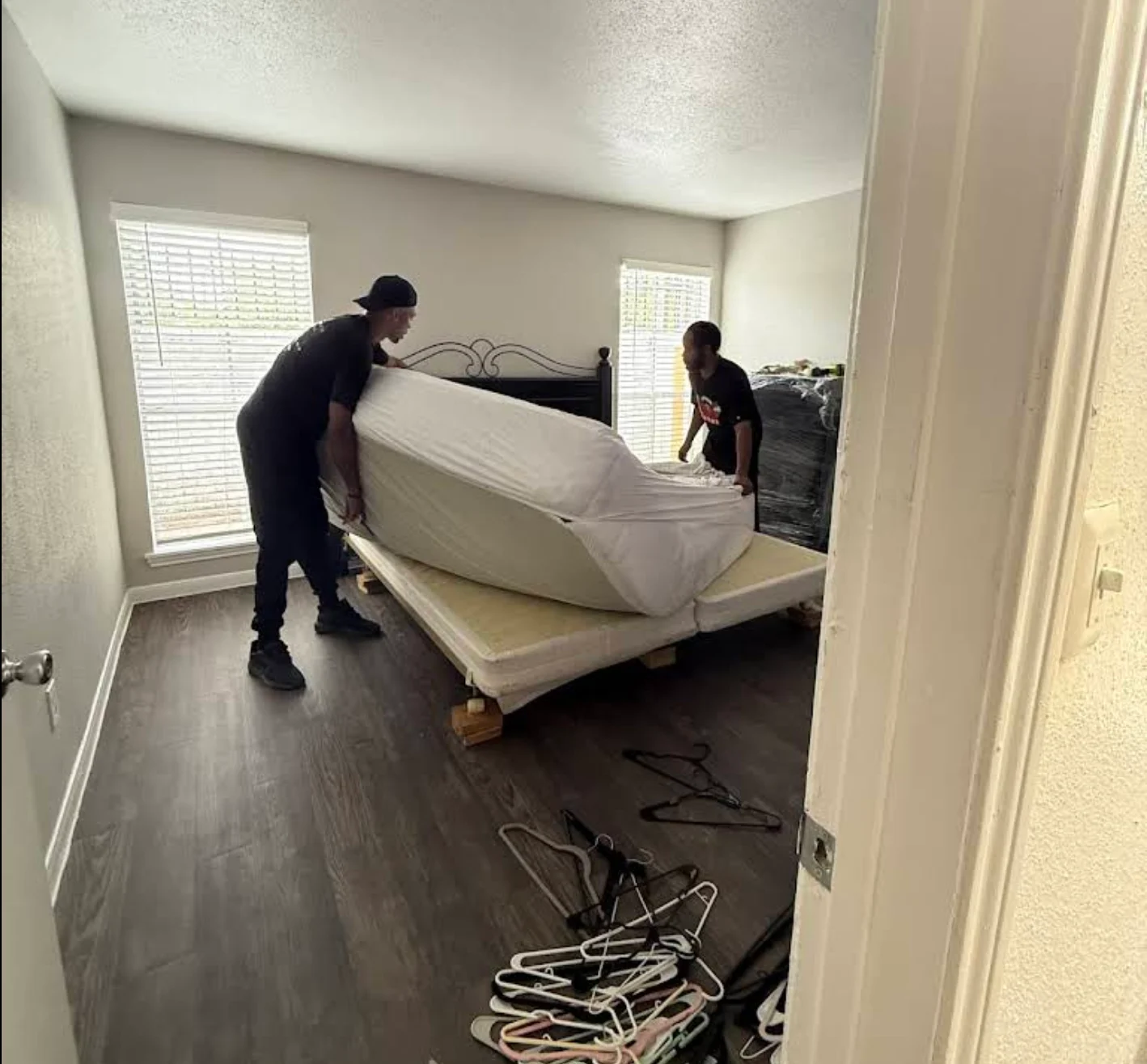
How to Move a Bed Frame Yourself Without Damage or
Injury?
I’ll never forget the first bed frame move I ever witnessed go spectacularly off the rails. One of my clients on the fourth floor of a walk-up in Montrose had stumbled across a blog post about how bed frames were the easiest pieces to move solo. A couple hours later, she was slumped on the landing of her apartment building, just one nut and bolt shy of reassembling the thing, entirely convinced she’d either somehow cracked the frame or ruined her back for good.
Look, she wasn’t totally wrong. When you’re learning how to move a bed frame, it truly is one of the more accessible DIY moving jobs. Provided you’ve had it demonstrated for you, or you know the exact sequence of events, and you have at least one of a handful of inexpensive tools, it really is fairly simple.
But that’s also where the fear comes from: “If I try to move it myself, I’ll damage the frame, gouge the walls and floors, or throw my back out trying to force something too heavy and awkwardly shaped through a door,” goes the argument I hear most often from folks preparing to relocate.
Then there’s the added cost of hiring movers for what, at the end of the day, is “just a bed.” Many feel trapped, stuck between the prospect of attempting it themselves and having absolutely no idea whether they’re doing it correctly or setting themselves up for a much bigger disaster.
In this guide, I’m going to break down everything I’ve learned over the last decade by helping people move thousands of beds, from simple platform beds and bulky metal frames to elegant wooden creations and everything in between.
By the time we’re done, you’ll know exactly how to move a bed frame, whether you’re just shuttling it down the hall or shipping it across the country. We’ll begin with the essential tools you’ll need and then walk through the process for each major frame type.
Table Of Contents[hide]
Tools You Need to Move Bed Frame
While a professional moving company will show up with dollies, straps, and pads specifically designed for just about every furniture-moving scenario, you really don’t need a whole arsenal to get the same result when moving a bed frame by yourself. A quick trip to your local hardware store, or even just a thorough raid of your garage or tool bin, should equip you for the job.
These are the key items that actually make a difference:
- Adjustable wrench (8-10 inch): Essential for loosening and tightening bolts and nuts found on most metal and platform bed frames. Available for around $5-$15 at any hardware store.
- Cordless drill/driver with Phillips and flathead bits: Not strictly necessary, but it significantly speeds up the process of removing screws from wooden bed frames. Budget anywhere from $30-$60 if you don't already own one.
- Allen wrench (hex key) set: Modern bed frames frequently utilize hex bolts. If your frame came with a hex key, use it! Otherwise, a full set typically costs $8-$12.
- Moving blankets or old bath towels: These protect the frame itself from scratches and guard your walls, doorframes, and floors from bumps and dings during transport. Free if you use towels, or about $15-$30 for new moving blankets.
- Furniture sliders: A must-have for moving your frame smoothly across floors without dragging or scratching. A set of four costs $5-$10.
- Hand truck or two-wheel dolly: Invaluable for navigating stairs or carrying the bulk of the frame’s weight down long hallways. You can buy one for $30-$50 or rent one for about $20 for a half-day.
- Painter's tape or masking tape: Useful for bundling loose pieces of hardware into labeled bags and for marking corresponding parts before disassembly if needed. Costs under $5.
- Small zip-top bags: Crucial for keeping bolts, screws, and washers organized by section or piece of the frame, preventing that dreaded “where did this go?” moment during reassembly. A box of 50 bags will run you about $3.
- Permanent marker: Perfect for labeling your zip-top bags and for making identifying marks on matching parts if necessary before you take anything apart. Chances are you already have one of these handy.
- Ratchet strap or bungee cords: If you're transporting your bed frame in a truck bed or an SUV, these secure it and prevent it from shifting. You can get a set for $10-$20.
- Work gloves: Protect your hands from splinters, sharp metal edges, and accidental pinches. Available for $5-$10.Work gloves: Protect your hands from splinters, sharp metal edges, and accidental pinches. Available for $5-$10.
- Stretch wrap (plastic furniture wrap): This stuff holds the moving blankets in place on the frame during transit. A roll costs about $10-$15.
Most of these items can be purchased for less than $100 total, and even less if you’re able to borrow or reuse items you already own and opt to rent a dolly. Still, it’s considerably less expensive than hiring professional movers for a single piece of furniture.
Important Considerations Before You Start
Before you even think about touching a bolt or screw, it’s absolutely imperative that you mentally-or actually-walk the entire path your bed frame will need to take. This is the part where most DIY moves go south.
Confirm these essential details:
- Measure everything: Before you begin disassembly, measure the width of your headboard and footboard, and the width of all doorways, hallways, and stairwells along your moving route. Compare these dimensions carefully to ensure clearance.
- Assess turns and obstacles: A hallway might be wide enough, but a tight 90-degree turn around a corner can be a significant challenge. Note any potential hang-ups.
- Document your disassembly process: Take pictures or videos of each connection point from multiple angles before* you start taking things apart. This is a lifesaver during reassembly.
- Locate manufacturer instructions: Check if the original manufacturer's manual is available online if you’ve lost it. A quick search can save you a lot of guesswork.
- Clear the area: Make sure you have at least a few feet of open space on each side of the bed frame for working and maneuvering.
- Enlist a helper: Even a relatively light platform frame can be awkward and difficult to carry alone, especially down stairs or through narrow spaces. A second pair of hands is highly recommended.
- Check the weather (if applicable): If you're loading the bed into a vehicle, rain can be problematic for both wood and metal frames.
- Reserve necessary facilities (if applicable): If you’re in an apartment building, book the service elevator or loading dock in advance.
Many DIY movers overlook this critical prep phase in the interest of saving time. What they don’t realize is that skipping these crucial steps often transforms what should be a simple task into a frustrating, multi-hour ordeal. Professional movers routinely perform these assessments automatically before they start, which is a major reason why their jobs typically run so much smoother.
How to Move a Bed Frame: A Step-by-Step Breakdown
The method for moving a bed frame will vary depending on the type of frame you have. A platform bed comes apart in a fundamentally different way than a metal frame, and a heavy wooden frame requires more caution than either. Here’s a breakdown of the process for common frame types, as well as some advice for moving without a truck and long-distance relocation.
Disassembling a Platform Bed Frame (Often the Easiest Option)
Platform beds tend to be the simplest frames to disassemble because they are usually comprised of a few large panels that connect with minimal hardware.
- Remove bedding: strip all mattresses, pillows, and bedding from the bed and set them aside, making sure they aren't in your way.
- Locate fasteners: Find and loosen all bolts connecting the headboard, footboard, and side rails. You’ll typically be dealing with 4 to 8 bolts total. Use your adjustable wrench to turn them counterclockwise.
- Organize hardware: As you remove each bolt and washer, place them in a labeled zip-top bag. This prevents them from rolling under furniture or getting lost.
- Separate the components: Detach the side rails from the headboard and footboard. Lay each panel flat on a moving blanket to protect its surface.
- Wrap and secure components: Wrap each panel individually in moving blankets or towels. Secure the blankets with stretch wrap or tape to keep them in place.
- Transport components: Carry each panel, one at a time, with your helper. Keep the panel vertical to reduce its overall width as you navigate doorways.
Safety Tip: Platform bed panels are primarily bulky rather than heavy. Communication with your helper is key when moving around corners and through doorways to avoid accidents.
Platform beds are the most straightforward precisely because they require so few small parts. If you encounter difficulty, it’s almost always due to a seized bolt. A little penetrating oil and a bit of patience can often loosen it without forcing it, which could cause damage.
Moving a Metal Frame Bed (Most Common)
Metal frames are the most common and come with the most hardware to deal with! Proper organization is your best friend for easy reassembly.
- Remove mattress; if it has a headboard or footboard that's connected, remove that too.
- Identify the type of bolts: most metal frames use either Allen hex bolts or standard bolts (requires adjustable wrench).
- Remove bolts at each corner, applying steady, consistent pressure to avoid scratching the finish.
- Carefully separate the frame into side rails, center support bar, and any headboard/footboard brackets.
- Place each component piece on a moving blanket. Bag up every single bolt, washer, and nut from each section.
- Label the bags clearly indicating the specific corner or joint they came from.
- Wrap any exposed metal edges and corners in towels or blankets; exposed metal can scratch floors, walls, and doorframes.
- Fold metal beds flat if your model has this feature - it dramatically saves space for transport.
- Stack flat parts and rails together, and strap them with a ratchet strap so they won't shift.
In my experience, the single most frequent problem I see with people trying to move a bed frame is losing hardware. I once helped a friend reassemble a frame and we were short three bolts; we found them the following weekend tucked behind a nightstand. Take photos of each joint before you begin, and label your hardware bags by section!
The most common mistake in reassembly is rushing it and forcing a bolt into the wrong hole; two brackets might look very similar, but if a bolt won’t thread easily by hand, re-check your photos before using the wrench.
Moving a Wooden Bed Frame (Requires Extra Care)
Wooden frames are often heavier and more prone to damage than metal or platform beds, so handle with extra care.
- Remove the mattress and check how the frame is held together; identify bolts, dowels, or glued joints (never try to force glued joints).
- Wrap corners and edges with moving blankets before starting to disassemble, as wood scratches more easily than metal.
- Loosen exposed bolts with an adjustable wrench, turning slowly to avoid damaging worn bolt holes.
- If the frame has dowels, gently rock or twist the pieces apart by hand; don't use a pry bar.
- Place each wood panel on a padded surface immediately after removal; leaning it against a wall might cause warping.
- Wrap each piece in moving blankets, taking special care with any finished or carved edges.
- If possible, use two people to carry panels – solid wood bed frames are deceptively heavy!
Some people ask about moving bed frames fully assembled. This might work for a lighter wood bed with simple joinery and if you have plenty of clearance. But for most wood frames, it’s a significant risk and safer to disassemble, even if the manufacturer says it can move whole.
I’ve seen too many beautifully crafted wooden beds chip or crack when trying to maneuver them through doorways at awkward angles.
Moving a Bed Frame Without a Truck (Apartment to Apartment)
For local moves (same building or just a few blocks), a truck isn’t always necessary.
- Use furniture sliders under the bed frame’s legs or corners. This reduces friction and protects flooring.
- Slowly slide the frame, adjusting at doorways and corners rather than trying to force it.
- Disassemble the frame before moving down stairwells; sliders don’t work on stairs.
- If moving to a nearby building, load the disassembled panels into a van or even a large SUV (seats folded down). Protect the pieces with blankets and make multiple trips if needed, rather than jamming everything into one overload.
- A truck only becomes essential once you're moving more than a mile or two, or if you have more belongings than a few car trips can accommodate.
Moving a Bed Frame Across Country (Long-Distance Considerations)
Long-distance moves introduce a whole new set of challenges. What might be safe during a short move could result in broken joints after hundreds of miles of road travel.
- Disassemble the bed frame completely, even if it could technically fit in the truck assembled; the vibration during a long journey puts a lot of stress on joints.
- Wrap each individual panel with blankets, not just the whole stack, to prevent pieces from rubbing together.
- Add extra padding around corners and joints for support.
- Group and clearly label all hardware bags in one designated box.
- Consider whether to drive it yourself, use a freight service, or hire a professional long-distance mover, depending on your budget and the value of the frame.
- Secure the frame components tightly in the truck with ratchet straps, not rope.
I’ve moved thousands of bed frames over my 8+ years in the moving industry, and the biggest danger is the road travel itself.
For a valuable bed frame, heirloom pieces, or long-distance moves, professional services like Power Movers use specialized padding and techniques and carry insurance that can save you more than the cost in the long run by preventing damage and the need for replacement.
Common Mistakes to Avoid
Over the years, I’ve seen thousands of moves and observed the same few common errors pop up repeatedly. Thankfully, most of these are easily avoided once you know what to watch out for.
- Skipping measurements — Guessing at doorway width instead of measuring leads to frames that get stuck halfway through a move.
- Forcing a frame through a tight space — Pushing harder instead of stepping back to reassess usually ends in a cracked panel or a dented wall.
- Losing bolts and hardware — Loose bolts tossed in a pocket or a junk drawer have a way of disappearing right when you need them.
- Skipping protective wrapping — An unwrapped metal or wood frame scratches easily against floors, walls, and other furniture during transport.
- Underestimating the weight — A solid wood or metal frame is often much heavier than it looks, and lifting wrong is how backs get hurt.
- Reassembling out of order — Attaching side rails before the headboard is secure often means starting over from a wobbly frame.
- Rushing the disassembly — Skipping photos to save five minutes usually costs an hour of guesswork later.
- Ignoring the weather — Loading an uncovered wooden frame into a truck during rain can warp the wood before you even arrive.
There are many, many common mistakes that can be made during a furniture move. Don’t worry if you’ve made a few, it is common and to be expected when you’re trying a task for the first time, and this is where a professional furniture mover is helpful. If these are some of the things that worried you about moving your bed frame, then it might be a sign that Power Movers’ help services can help you out. Learn more about the services Power Movers offers here!
When to Hire Professional Movers?
Sometimes time, tools, or sheer physical capacity may make moving your bed frame not feasible on your own. There is absolutely nothing wrong with calling a professional movers for help. Here are some signs you might benefit from calling movers:
- You’re moving a large, heavy antique or solid wood bed frame that may be difficult for 2 people to lift safely.
- Your route involves going down or up multiple flights of stairs – even more so if it’s an older building with no elevator.
- There are narrow hallways and tight turns in your building where navigating the bed frame would be a challenge.
- You are moving a very long distance, possibly across the country and need assurance that the frame will be protected for the journey.
- You are recuperating from a serious injury or have mobility issues that prevent you from doing strenuous activity such as heavy lifting.
- You have invested in an antique bed frame with a high dollar value, or it holds sentimental value, and the cost of repair is significantly higher than the cost of having a moving crew transport it.
Professional movers utilize specialized equipment, are covered by insurance, and have the extensive experience needed to move items with minimal difficulty. Whatever works best for your moving situation is the right move.
Reassembly Tips
Where things go wrong during the disassembly and move, often as the last steps are being completed – this could mean your last few minutes have gotten much longer than anticipated. Don’t forget to use your photographs!
- Place all panels in the room where the frame will be going, along with hardware bags, and lay your photos out in front of you.
- Reassemble in reverse order of how you removed them: Reinstall the headboard, footboard, and side rails before your center support bar (if you have one).
- Before using any tools to tighten hardware, go over the frame by hand-tightening everything first. This allows you to identify misaligned brackets without forcing hardware into place.
- Make your bolts “snug” but don't over-tighten them, you do not want to strip any threads!
- Push down firmly on the corners of the reassembled frame to test its stability before putting your mattress and box spring on.
- Pack away your cardboard, bubble wrap, and plastic wrap for recycling, don't leave a mess.
Reassemble your frame in reverse order. Always be sure not to force any components together. If they aren’t fitting easily, and they’re not aligning properly with photos you’ve saved, don’t push your luck. You’re on the verge of causing some unnecessary damage.
Considerations For Moving Your Bed Frame
When it comes to dismantling or assembling any type of furniture, it can be more challenging than you expect, and there is a preparation process involved for each different furniture type. Take time to read the instruction and gather the required tools beforehand whether it’s a standard bed frame, an antique wood bed frame or a more complex futon or day bed.
The process often takes longer than most people realize, especially the first time you move a bed frame, but the time invested is a valuable process. If during the process of moving your frame, it becomes clear it’s more than what you’re equipped to handle, whether due to time, physical strength, or the stairwell design – that’s a clear indication to turn to professional assistance.
It’s your move, but hopefully, knowing a little about the steps will help you determine the best approach for your furniture move. With that in mind, will you DIY your move or opt for professional help?

Article written by
Gary founded Power Movers in 2007 after watching too many moving companies damage or steal from customers with no consequences. The company runs on one rule: every crew member gets background-checked, trained, and held to the same standard Gary was held to as a police officer. Over 9 years in, Power Movers handles local and long-distance moves, specialty items, and corporate relocations for Houston businesses including Tesla and Airgas.