
How to Move a Water Heater: Guide for Gas, Electric, and Tankless Units
Knowing how to move a water heater safely is more than a lifting problem. A tank water heater is heavy, awkward, and connected to your plumbing, your gas line or electrical circuit, and sometimes a vent. Do it wrong and you risk a gas leak, a scald, a flooded floor, a hurt back, or a ruined tank. Do it right and the job is straightforward.
- Check whether it's worth moving. Older tanks, rentals, and homes you're selling are often better left in place.
- Shut off power or gas, shut off the water, and let the tank cool before you touch anything.
- Drain the tank completely. Water weighs about 8.3 pounds per gallon, so a full 40-gallon tank holds over 330 pounds of water alone.
- Use a hand truck or appliance dolly and two people. Even an empty tank is heavy and awkward.
- Keep it upright whenever possible, and check your manual before laying it down.
- Use a licensed plumber for gas, venting, and reinstallation unless you're doing the work yourself on your own homestead, and get the permit.
Table Of Contents[hide]
Is It Worth Moving Your Water Heater?
Before you spend a weekend on this, consider whether it makes sense.
Age. A tank water heater generally lasts about 10 to 15 years, depending on the type and maintenance. If yours is near the end of its life, moving it means paying for labor, new parts, and a permit for a unit that may fail soon after. Replacing it may be the better value.
Warranty. Many manufacturer warranties cover only the original installation, so relocating the unit can affect coverage. Check your warranty.
Code upgrades. Moving a heater often means bringing the installation up to current code, including new connectors, a new relief valve, a drain pan, and possibly an expansion tank.
Who owns it. If you rent, the water heater belongs to your landlord. If you’re selling your home, permanently installed fixtures generally convey with the property unless your contract says otherwise. In Texas, check Paragraph 2 of the TREC resale contract and talk to your agent before you plan to take a water heater with you.
Tankless and heat pump units. These cost more, so moving them is more likely to be worthwhile, but they also need more careful handling.
Safety Precautions
- Gas. If you smell gas, don’t turn lights or switches on or off, don’t use a cell phone or anything that could spark, and leave immediately on foot. Once you’re safely away, call 911 and your gas utility. CenterPoint Energy serves much of the Houston area. Don’t try to operate gas valves during a suspected leak.
- Electricity. Turn off the breaker for an electric heater, and confirm that the power is off with a voltage tester before touching any wires.
- Hot water. Water in a tank can cause serious burns. Shut off the heater and let the water cool before draining. Some guides say to wait 30 minutes to a couple of hours, and overnight is safer.
- Weight. Even an empty 40- or 50-gallon tank commonly weighs roughly 100 to 160 pounds, and it’s awkward to grip. Never try to move one alone.
- Carbon monoxide. A gas water heater that’s vented or reinstalled incorrectly can release carbon monoxide, which is colorless and odorless. Have a plumber check the venting, and make sure you have working CO detectors.
- Attics and tight spaces. Many Texas homes have water heaters in attics, garages, or closets. Attics can be far hotter than the air outside, and carrying a heavy tank down attic stairs or a pull-down ladder is dangerous. Hire a professional for attic units.
Do You Need a Permit or a Licensed Plumber in Houston?
In most cases, yes to a permit, and often yes to a plumber.
- City of Houston permit. The Houston Permitting Center says a plumbing permit is required for the replacement and installation of water heaters. An inspection is required, and plan review isn’t needed for single-family homes. Permits are valid for 180 days.
- Licensed plumber. In general, plumbing work must be done by a plumber licensed by the Texas State Board of Plumbing Examiners, and a master plumber registered with the City of Houston pulls the permit.
- Homestead exception. Texas law says a property owner doesn’t need a license to do plumbing in their own homestead. The City of Houston also issues a homeowner’s plumbing permit if you own, occupy, and have the property registered as your homestead. This does not apply to rental or commercial properties.
Even if you’re allowed to DIY, gas piping, venting, and relief valves are areas where mistakes are dangerous. If you aren’t completely comfortable with them, hire a licensed plumber.
Things you'll need
- A hand truck or appliance dolly with a ratchet strap or two
- A helper (and a second one for stairs)
- Garden hose long enough to reach a floor drain or the outdoors
- Adjustable wrenches and pipe wrenches, channel locks, and screwdrivers
- A voltage tester (electric units)
- Gas leak detector solution or soapy water (gas units)
- Buckets and towels
- Work gloves, safety glasses, and closed-toe shoes
- Moving blankets or padding
- Ratchet or cam straps for transport
- For reinstallation: new flexible water connectors, a new gas flex connector (gas units), a new T&P relief valve and discharge pipe, a drain pan, thread sealant rated for gas or water, and an expansion tank if your system requires one
Steps to Move a Water Heater
Step 1: Plan and Prep
- Check the manual or the label for your model’s instructions and its dimensions.
- Measure the route and the vehicle. A tall 40- or 50-gallon heater can be 5 feet or more in height.
- Clear the path and protect floors with blankets or cardboard.
- Line up help, and arrange permits and plumber appointments if you need them.
Step 2: Shut Off Power or Gas
- Electric heaters: Switch off the breaker. Use a voltage tester at the junction box to confirm power is off before touching any wires.
- Gas heaters: Turn the gas control to off (or pilot, per your manual), and close the gas shutoff valve on the supply line at the heater. Don’t shut off the gas at the meter. Leave the pilot or ignition off.
Step 3: Shut Off the Water and Let It Cool
Close the cold-water inlet valve on top of the heater. Open a hot-water faucet somewhere in the house to let air into the lines so the tank drains easily. Give the water time to cool, since draining hot water can scald you.
Step 4: Drain the Tank
- Attach a garden hose to the drain valve at the bottom of the tank.
- Run the other end to a floor drain, a utility sink, or outdoors, on ground lower than the tank.
- Open the drain valve. Opening the T&P relief valve (the lever on the valve) can help water drain faster.
- Let it run until the tank is completely empty and the water runs clear.
- If the water slows or stops, sediment may be clogging the drain valve. Briefly turn the cold-water inlet back on to stir up and flush the sediment, then shut it off again.
Draining matters. A full tank can weigh hundreds of pounds more than an empty one, and it isn’t safe or practical to move.
Step 5: Disconnect Everything
- Water lines: Unscrew the hot and cold flexible connectors or unions at the top of the tank, using two wrenches so you don’t twist the pipes. Keep towels handy for the remaining water.
- Electric heaters: After confirming the power is off, remove the access panel, disconnect the wires, and cap them with wire nuts.
- Gas heaters: Disconnect the gas line at the union or flex connector. Cap or plug the open gas line. Disconnect the vent (flue) pipe from the draft hood. This is the step where a licensed plumber is most strongly recommended.
- T&P valve discharge pipe and pan drain: Disconnect and remove them.
- Expansion tank (if present): Release its pressure and disconnect it.
Step 6: Move the Tank
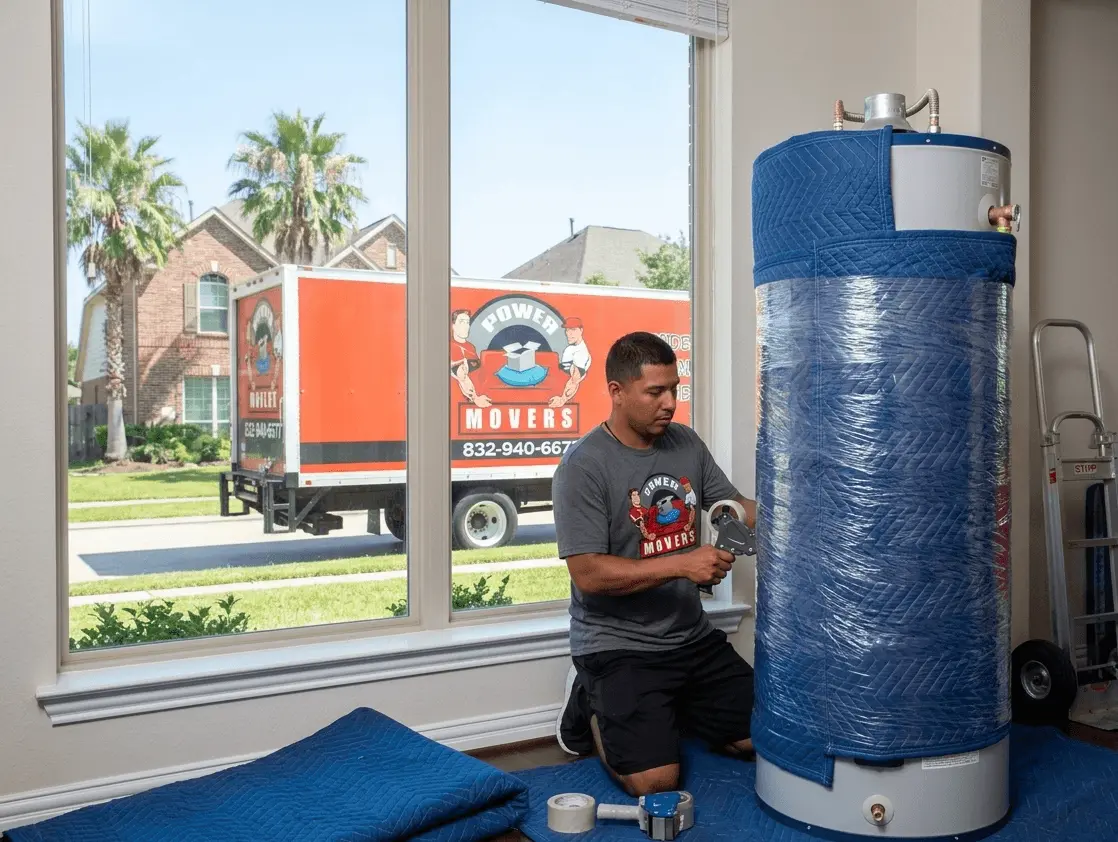
- Tilt the tank back just enough to slide the dolly’s nose plate under the base, then strap it on with the ratchet strap, snug and centered.
- Have a helper steady the tank, and roll it slowly. Push the dolly instead of pulling it.
- Use a ramp for steps or thresholds, and avoid lifting with your back.
- Stairs: Use two or more people, and consider a stair-climbing hand truck. Don’t try to carry a full-size tank down stairs alone, especially from an attic.
- Protect the floor and the tank. Padding keeps the paint and fittings from getting damaged, and the glass lining inside can be damaged by rough handling.
Step 7: Transport the Water Heater
- Keep it upright whenever possible. Upright is the safest way to protect internal components, and some models, particularly heat pump (hybrid) units, must be transported upright. Check your manual. Some manufacturers allow certain models to lie on their back or side, while others say to keep the unit upright only.
- A pickup truck is the easiest option, with the tank strapped securely and padded. A tall tank may not fit upright in an SUV or van.
- Secure it with ratchet straps so it can’t shift, tip, or roll, and pad anywhere it touches the vehicle.
- Handle it gently. A bump to the fittings or bottom can cause leaks later.
- If you lay it down, do it only if the manual allows, and let it stand upright for a while before use, as some guides recommend.
Step 8: Reinstall at the New Location
This is where permits and inspections matter.
- Prepare the location. The area needs the right clearances, a drain pan with a drain, a supply of water, and the correct gas or electrical connections. For gas units, the vent must be installed correctly and must have adequate combustion air.
- Raise it in a garage if required. Under the model residential code used by Texas cities such as Georgetown, a gas water heater installed in a garage generally needs to be raised 18 inches, unless it’s listed as flammable-vapor-resistant. Electric heaters are not required to be elevated. Ask your plumber or inspector about local requirements.
- Set the heater on a drain pan.
- Use new parts. Manufacturers such as A. O. Smith say to use a new T&P relief valve. New flexible water connectors are a smart choice, and gas flex connectors can’t generally be reused. A sediment trap is typically required for gas lines.
- Install the T&P discharge pipe correctly. It should run to an adequate drain or outside. It should not drain into the water heater pan, and it must never be capped, plugged, or reduced. Don’t place a valve between the tank and the relief valve or the end of the discharge pipe.
- Connect the water lines. Install a full-size shutoff valve on the cold-water inlet. Add an expansion tank if your system needs one, which is typical with a closed system such as one with a backflow preventer.
- Connect the gas or electricity. For gas, test every joint for leaks with soapy water or leak detector solution. For electric heaters, reconnect the wires and secure the access panel.
- Connect the vent pipe for gas units, and have it checked.
Step 9: Fill, Test, and Start Up
- Open the cold-water inlet and a hot-water faucet, and let the tank fill completely. Wait until water flows steadily from the open faucet.
- Check for leaks at every connection.
- Only then restore power or gas. Energy Trust of Oregon advises waiting at least 15 minutes for the tank to fill before turning an electric heater’s breaker back on. Energizing an empty electric tank can burn out the heating elements.
- For gas units, relight the pilot following the label instructions, or call a plumber. Check the flame and the venting.
- Set the temperature. 120°F is a common recommended setting.
- Schedule the inspection if a permit was required, and check for leaks again after the first day.
Moving Different Types of Water Heaters
- Gas tank heaters. The most complex. Gas lines, venting, and combustion air all need to be right, so use a licensed plumber for disconnecting and reinstalling.
- Electric tank heaters. Simpler, because there’s no gas or flue, but you still have to shut off the breaker, confirm the power is off, and fill the tank before restoring power.
- Tankless units. Much lighter than tank models, but they’re wall-mounted, with gas or electrical connections, venting, and water lines. Shut off power or gas and water, and drain the remaining water before moving them. Check the manufacturer’s instructions for flushing and handling. Have a professional reinstall one.
- Heat pump (hybrid) units. Heavier and top-heavy, with a built-in refrigeration system. Many manufacturers say they must be moved upright. Follow your model’s instructions and use extra help.
Bringing a New Water Heater Home
- Measure your vehicle and the route first.
- Leave it in its box if possible, since the packaging protects its components.
- Use a hand truck and a helper to get it into a truck, and strap it so it can’t move.
- Check the carton or manual for orientation instructions before laying it down. A new heat pump unit should stay upright.
- Consider delivery, which many retailers and plumbers offer.
Getting Rid of an Old Water Heater in Houston
- Drain it fully and disconnect it from everything.
- Heavy trash. The City of Houston’s heavy-trash program may collect junk waste such as appliances on a schedule that alternates with tree waste. Check the city’s heavy trash page, the HTX Collects app, or call 311 for current rules and dates.
- Scrap metal recyclers often take drained water heaters.
- Ask your plumber or retailer. Many will haul away your old unit when installing a new one.
- Don’t set out hazardous items. Chemicals, fuels, and electronic scrap should go to a City of Houston Environmental Service Center, not the curb.
Moving a Water Heater in Houston, TX: Local Tips
Check permit and licensing rules first. The City of Houston requires a plumbing permit for installing or replacing a water heater, and an inspection is required. Homeowners who own and occupy their homestead can apply for a homeowner’s permit, but rental and commercial properties are different.
Beware of heat. In late July 2026, forecasters expected heat index values of 108 to 110°F in the Houston area. Attics and garages can be hotter still. OSHA and NIOSH advise drinking water every 15 minutes in hot conditions and taking breaks in shade or air conditioning. Signs of heat exhaustion include weakness, wet skin, headache, dizziness, and nausea. Heat stroke, with confusion, fainting, or hot dry skin, is a medical emergency, so call 911. Do the work early in the morning, or hire help for attic units.
Mind the location. Garage installations may need an elevated platform, and attic installations need a safe working platform, a drain pan, and a proper drain. Ask your plumber what applies to your home.
Gas safety. CenterPoint Energy advises people who smell gas to leave immediately on foot, then call 911 and the utility, and says not to use anything that could spark inside. If your home has flooded, call a licensed plumber or gas appliance technician to inspect appliances and gas piping before gas service is reconnected.
DIY or Hire a Pro?
Situation | Best choice |
Carrying a drained, disconnected tank out of the house | DIY with two or more people and a dolly |
Transporting a new or removed tank in a pickup | DIY with a helper and good straps |
Disconnecting or reconnecting gas lines and venting | Licensed plumber |
Relocating a heater to a new spot with new plumbing or gas runs | Licensed plumber |
Attic units or tight, hard-to-reach spaces | Professionals |
Tankless or heat pump units | Professionals |
Rental or commercial property | Licensed plumber and permit |
Common Mistakes to Avoid
- Moving the tank before it’s fully drained and cool
- Shutting off the wrong valve or forgetting to confirm that power is off
- Trying to carry the tank alone
- Laying a heat pump or other upright-only model on its side
- Reusing old flexible connectors and the old T&P relief valve
- Draining the T&P discharge pipe into the drain pan, or capping it
- Turning on an electric heater before the tank is full
- Skipping the leak test on gas connections
- Skipping the permit and inspection
- Working in an attic in the midday heat
Let Power Movers Help
A licensed plumber should handle the gas, water, and electrical connections, but the heavy lifting and hauling is where we can help. Our moving labor team can help carry and load heavy items once they’re disconnected, and our specialty movers handle heavy and awkward pieces. If you’re moving your whole home, we offer local moving and long-distance moving, plus packing and unpacking services. We serve Houston, Spring, Katy, Sugar Land, and Cypress. Call and ask whether we can carry a drained, disconnected water heater for your job.
Need a hand? Call (832) 940-6683 or request a free quote.
FAQs
Not safely. Even an empty tank commonly weighs roughly 100 to 160 pounds and is awkward to grip. Use a hand truck and at least one helper. A licensed plumber should handle gas, venting, and reconnection unless you’re doing the work on your own homestead and are fully comfortable with it.
Yes. Water weighs about 8.3 pounds per gallon, so a full tank adds hundreds of pounds. Shut off power or gas, close the water, let it cool, and drain it completely.
It’s safest to keep it upright. Some models may be laid down according to their manuals, but heat pump (hybrid) units generally must stay upright. Check your manual or contact the manufacturer before laying a unit down.
It’s possible, but it’s often not worth it, especially for an older tank. It also may not be yours to take, since fixtures generally stay with a home being sold unless the contract says otherwise. Check your sale contract or lease.
The City of Houston requires a plumbing permit for the replacement and installation of water heaters, and an inspection is required. Homeowners who own and occupy their registered homestead can apply for a homeowner’s permit. Call the Houston Permitting Center to confirm requirements for your situation.
Texas generally requires a licensed plumber for water heater installation, with an exception for owners working on their own homestead. Renters and owners of non-homestead properties should use a licensed plumber.
Manufacturers recommend using a new T&P relief valve, new flexible water connectors are the safer choice, and gas flex connectors generally can’t be reused. Ask your plumber.
Let water flow steadily from an open hot-water faucet, and wait at least 15 minutes for an electric tank to fill before turning the breaker back on. Running an electric heater on an empty tank can burn out the heating elements.
Costs depend on whether the heater is gas or electric, how much plumbing, gas, and venting work is needed, the location (attic, garage, or closet), and permit fees. Get quotes from licensed plumbers, and ask Power Movers about help carrying the unit.
Drain it and disconnect it, then ask your plumber to haul it away, take it to a scrap recycler, or check the City of Houston’s heavy trash program and 311 for pickup rules.
Moving a water heater comes down to preparation: shut off the energy, drain and disconnect the tank, use a dolly and a second person, keep the unit upright, and have the reinstallation done to code with a permit. Be honest about what you can safely do yourself, and bring in a licensed plumber and extra hands when it gets heavy or involves gas. When you need help carrying the load, Power Movers is a phone call away.
Sources:
- Houston Permitting Center, water heater permit
- Houston Permitting Center, homeowner’s plumbing permit
- Houston Residential Permitting 101
- Texas Occupations Code §1301.051, homestead plumbing
- CenterPoint Energy, natural gas safety
- City of Georgetown, water heater permit and garage platform
- City of Boise, water heater install guide
- A. O. Smith, T&P valve and discharge pipe
- Energy Trust of Oregon, draining and refilling
- Nebraska Energy Office, water heater lifespan
- Hunker, hybrid units and side transport
- GE Appliances, GeoSpring transport
- City of Houston, heavy trash collection
- City of Houston, Environmental Service Centers
- TREC One to Four Family Residential Contract
- OSHA/NIOSH hazard alert, working in hot weather
- KPRC Click2Houston, Houston heat

Article written by
Gary Williams founded Power Movers, a Houston moving company with more than 1,000 reviews. He spent 12 years with the Houston Police Department’s Central Division, where moving-company complaint calls were part of what pushed him to start the business. Power Movers has worked with Tesla, Lululemon, and the Houston Rodeo, and is featured in Forbes Advisor’s Best Moving Companies in Houston list.