
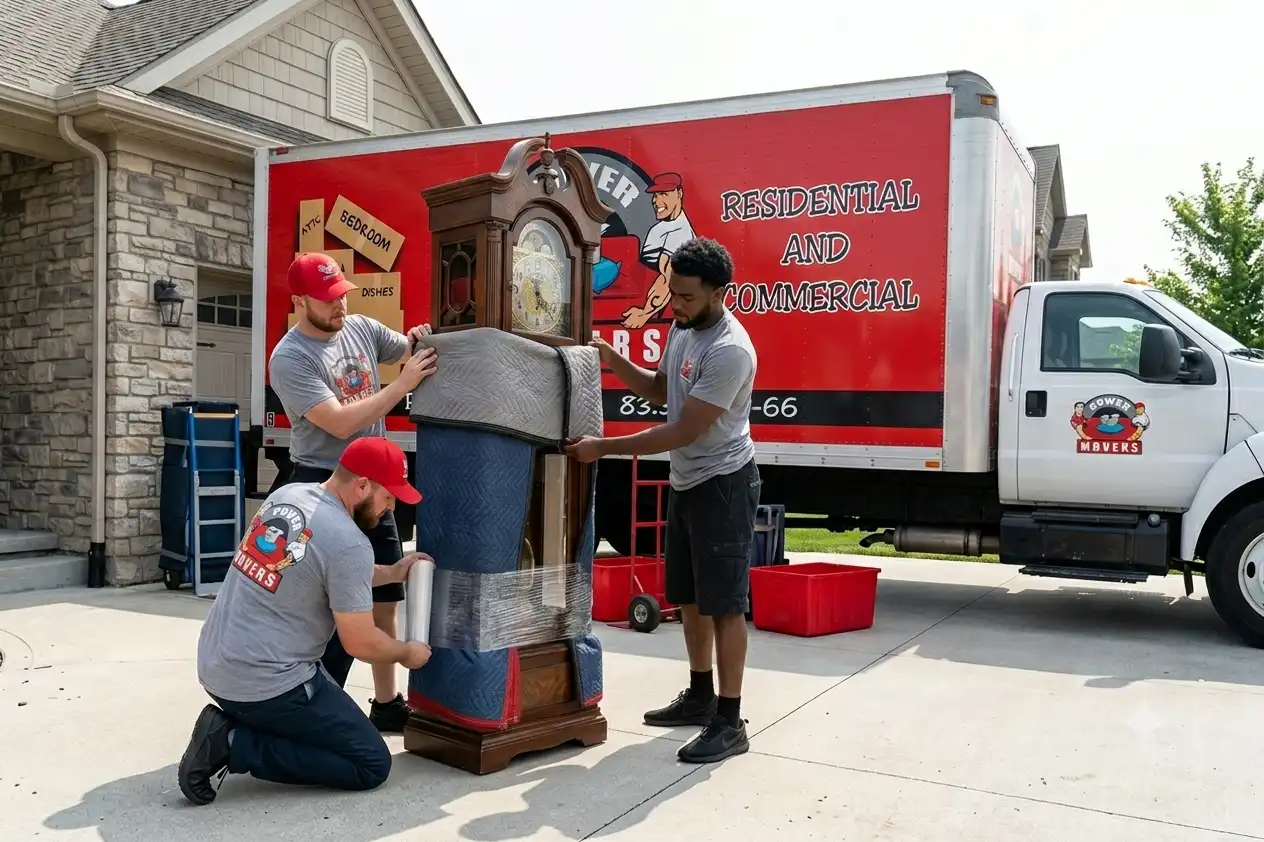
TL;DR: Grandfather Clock Moving Costs at a Glance
Moves of grandfather clocks locally can cost anywhere from $300 to $800, whereas professional local moves can range from $500 to $2,000. Long-distance moves conducted by professional movers generally fall between $1,500 to $5,000. Cross-country moves can even reach $3,000 to $8,000 and beyond.
How Much Does It Cost to Move a Grandfather Clock?
I vividly recall a conversation with a customer who had attempted to move his grandfather clock himself a few months prior in an effort to save money.
During the move, the pendulum swung loose within the clock’s case and damaged the interior workings, resulting in a repair estimate of $1,500, nearly double what a professional mover would have charged. Distressed, he called us at Power Movers to inquire if we could move his now non-operational clock to a repair shop across town. What he initially believed to be a saving of $300 to $500 ballooned into thousands.
Perhaps that initial customer’s story resonates with you. If you’re looking to determine how much does it cost to move a grandfather clock, you’ve come to the right place! I will provide an in-depth analysis of the real costs associated with both DIY and professional clock moving, delve into the factors influencing pricing, and help you decide which option is more financially viable for your unique situation.
Let’s begin by examining the various cost structures based on distance.
Table Of Contents[hide]
Understanding Grandfather Clock Moving Costs by Distance
It is difficult to overstate the impact of distance on grandfather clock moving costs. Whether it’s a short jaunt across town or an intercontinental journey, the logistics, equipment required, and risk involved are vastly different, thus the significant price variations below. Identifying the category your move falls into is the quickest way to establish a realistic budget, regardless of your preferred moving method.
Local Grandfather Clock Moving Costs (Same City or Within 50 Miles)
Local Grandfather Clock Moving Costs (Within 50 Miles of Pickup City) When relocating your grandfather clock within your city or up to 50 miles, a DIY approach generally costs between $300 to $800, factoring in the rental of dollies, packing supplies, and a truck or van for a few hours.
Professional local moving services for grandfather clocks usually range from $500 to $2,000, depending on the level of service and ease of access at both locations.
This cost typically covers labor, packing materials, insurance, and specialized equipment for handling such a heavy and awkward item. However, DIY moves can accrue hidden costs quickly: dolly rental can run $30-$50 per day, packing supplies might be $50-$150, and renting a truck adds another $25-$75. In my experience, most local moves of grandfather clocks that end in disaster occur when individuals underestimate the complexities.
A DIY move that appears to cost $700 could actually turn into a $2,700 disaster if $2,000 in damages occurs. It starts making financial sense to invest in professional moving services when the value of your clock exceeds $3,000.
Long-Distance Grandfather Clock Moving Costs (200-1,000 Miles)
For moves between 200 and 1,000 miles, DIY moving expenses can increase significantly, typically between $1,200 and $3,500, which covers truck rental, materials, fuel, and the time you spend on the road.
Professional long-distance moving services for grandfather clocks will usually cost from $1,500 to $5,000, depending on the distance and type of service you choose.
This pricing encompasses labor, packing, custom crating if necessary, insurance, fuel, and specialized moving equipment. The hidden costs for DIY moves are amplified at this distance. You could experience excessive wear and tear on your own vehicle (if you don’t rent a truck), extended rental periods if your trip takes longer than anticipated, gas costs for multiple days of driving, and accommodations for overnight stays.
Insurance is a critical factor that separates DIY and professional moves here: most DIY attempts come with zero insurance coverage, whereas professional movers include it as part of their standard service.
Cross-Country or Interstate Grandfather Clock Moving Costs (Over 1,000 Miles)
If your grandfather clock is destined for a location over 1,000 miles away, DIY costs can range from $2,500 to $6,000 or more when you factor in extensive truck rentals, packing materials, and the logistical complexities of shipping a fragile item across the country.
Professional cross-country moves of grandfather clocks typically range from $3,000 to $8,000 or more, varying by distance and service level. These prices include specialty moving, custom crating for maximum protection, insurance, and fuel costs. Specialty Moving DIY hidden costs can quickly spiral at such distances, including numerous overnight hotel stays, weeks of truck rental, and significantly increased risk with every mile.
Verifying and filing insurance claims for DIY cross-country moves is incredibly challenging, if not impossible, while professional insurance is documented and a standard inclusion in their service. In summary, the farther your grandfather clock has to travel, the more financially sensible professional moving becomes. For cross-country trips, the cost of DIY and professional moves can appear similar, but the assurance of insured transport with professional movers is invaluable.
Factors That Affect Grandfather Clock Moving Costs
While distance is a primary driver of cost, several other factors can significantly impact the price of moving your grandfather clock by hundreds or even thousands of dollars.
Many people overlook some of these critical elements when setting their budget or preparing for a DIY move, which can lead to unwelcome surprises.
- Clock size and weight: Heavier, larger grandfather clocks will require more labor and specialized equipment. The weight will also determine whether one person can manage the move or if multiple helpers are needed.
- Clock age and condition: Older, antique clocks may require delicate handling and specific care. Clocks in poorer condition might necessitate professional crating and climate-controlled transport.
- Clock value: Grandfather clocks valued at $5,000 or more may require specialty insurance and a white-glove service, making professional movers a worthwhile investment.
- Accessibility at pickup and delivery locations: The presence of stairs, narrow hallways, or tight doorways can increase the cost, as professional movers will charge more for challenging access points.
- Disassembly and reassembly: Moving a clock intact is less expensive than one that requires disassembly. Professional movers will charge an additional $200 to $500 for these services.
- Packing and crating requirements: Simple blanket wrapping is less costly than custom wooden crating. For clocks valued over $3,000, custom crating is usually recommended and can cost anywhere from $300 to $800.
- Distance of the move: While the per-mile rate generally decreases with longer distances, the overall cost increases due to the extended travel time and increased potential for issues.
- Time of year: Peak moving seasons (summer months) typically come with a 20-30% premium in pricing, while moving during the off-season (winter) may result in discounts.
- Insurance and liability: Full replacement insurance is more expensive than standard moving insurance, and high-value clocks may need to be insured under specialized policies.
- Specialty equipment: If your move requires specialty equipment like climate-controlled vehicles, specialized dollies, or white-glove service, you can expect additional costs ranging from $200 to $600.
Most people underestimate three or four of these factors, leading to a seemingly reasonable estimate quickly ballooning into a much larger bill. Professional movers meticulously consider all these aspects before providing a quote, assessing your clock, home, and access points to give you an accurate and comprehensive estimate.
Hidden Costs People Often Overlook When Moving a Grandfather Clock
These are the costs that don’t turn up until you’re deep in the move and have no choice but to pay. This is where a budget DIY project becomes an eye-watering, wallet-emptying expensive one.
- Moving materials: Bubble wrap, kraft paper andwooden cratingboxes: $100-$250 per clock.
- Equipments: Dollies, hand trucks and straps: $50-$150per day.
- Travel: Food, fuel and hotels for DIY cross-country: $700-$1,500.
- Clock/home damage: Scratches, dents, breakage: $1,000-$10,000.
- Tools you'll need: Screwdrivers, wooden blocks andspecialty tools: $80-$300
- Repair costs if damage happens: Very costly if done after the fact.
- Time: You won’t be paid for 8-16 hours spent on a move.
- Climate-controlled storage: $70-$350 per month.
This collection of extra costs can turn a seemingly $400 DIY move into a $1200 or more nightmare! That’s often much more expensive than simply hiring a professional company from the outset, even when accounting for other considerations. Thinking about ALL these hidden costs rather than just one or two of them is the reason why a professional service can be cheaper than doing it yourself for many people.
DIY Moving versus a Professional Clock Mover: Cost & Risk Comparison
Here’s how two scenarios pan out in realistic terms rather than wishful estimates.
DIY Moving
Here’s how two scenarios pan out in realistic terms rather than wishful estimates.
- Initial outlay: $500-$5,500 depending on distance.
- Time commitment: 4-16+hours.
- What you’ll need: Dolly, blankets, packing supplies and tape.
- Insurance: None or very limited; all risks of damage lie with you.
- Damage risk: 15-25% (for expensive clocks) and potentially higher.
- Expertise required: Moderate to high, as mistakes are extremely expensive.
- Hidden costs: $400-$1,600+ unexpected expenses.
- Total cost with damage and repairs: $4,000-$15,000+.
Professional Moving
- Total cost: $800-$14,000 depending on the service level and distance.
- Your time commitment: 2-4 hours (as you don’t do the labor!).
- What they’ll use: Professional-grade equipment, crating and vehicles.
- Insurance: Full cover (usually standard or as an add-on for a small premium).
- Damage risk: 1-5%(very low, with specialty moving near zero).
- What they know: Crews trained for fragile and specialty items.
- Hidden costs: Minimal; costs are all-inclusive.
- Total cost with full insurance cover: $900-$18,000.
If your clock is valued at $3,000-$6,000 or above, it actually makes more financial sense to use a professional. I’ve worked in the industry for over a decade, and I’ve seen many people save $400 on a DIY move, only to spend $6,000 on repairs because of damage. When you calculate the real total cost of DIY (including insurance, damage risk, and hidden expenses), it’s far more common to find that professional movers are actually cheaper, as well as significantly safer.
Specialty and High-Value Bottles (Rare, Antique, Collectible)
There are real costs involved in moving even the most simple clock, other than the cost of your own labor. It is wise to identify all these costs before deciding whether to tackle the task of moving a grandfather clock yourself. Very few people only plan for one or two these costs!
- You'll have costs for equipment rental, which include hiring a dolly ($40 to $60per day), moving blankets ($10 to $60 to buy, $10 to $20 to rent), packing tape ($10 to $200), and rope or straps ($20 to $30).
- You'll also pay for packing supplies like bubble wrap ($20 to $40), kraft paper ($10 to $30) and wooden blocks or shims ($10 to $20).
- Transportation costs: Moving van rental averages $50 per day for a small van, and $100 per day for a larger one, depending on distance.
- Contingency: Set aside 20%-30% for unplanned expenses, such as tools you realize you need or materials you forgot to buy.
- Your own time value: how much do 4-8 hours spent on moving the clock actually cost you?
Adding all this up and your actual DIY costs are rarely just for the supplies. A move that initially looked to cost $550 can suddenly cost $800 or $900 once you’ve calculated everything you need. Although this is generally less expensive than hiring professionals for local moves, the cost gap can disappear, especially if you encounter any unexpected problems.
Factors To Take Into Account When Planning YourDIY Grandfather Clock Move
Cost is not the only factor to consider when deciding whether it’s sensible to attempt a DIY move of a specialist grandfather clock. These other factors are critically important and will ultimately determine whether you have a successful move or a financially painful failure. Run through this checklist with brutal honesty:
- Clock constructioncomplexity: Simple hardwood cased clocks are much easier to transport than ornatemechanical grandfather clocks.
- Site accessibility: Easy access with ground floor, large doorway locations cost nothing extra. Access involvingstairs and tightcorners will dramatically increase both effort and costs.
- Distance: A short local move is potentially doable; a DIY cross-country move involves exponential risk increases.
- Physicality: Do you have the strength required to lift 100-300 lbs and navigate hazards without assistance?
- Human power: Can you get the help of one or two very strong individuals who will donate their time (and physical labor) for 4-8 hours?
- Equipment: Can you cheaply rent or borrow all the necessary equipment in your vicinity?
- Clock value & insurance: Is your grandfather clock valuable enough for the risk of damage to outweigh the money you would save on DIY?
- Your experience level: Have you previously moved special or fragile items, oris this your first attempt at transporting delicate objects?
- Your personal ability to cope with stress: How comfortable are you taking full responsibility for the safe move of a significant heirloom?
Step-by-Step Guide: What DIY Moving Costs and How to Do It (Budget Breakdown)
This next section walks through the actual moving process with a cost attached to each step, not just a generic how-to. If you’re weighing DIY grandfather clock moving vs. professional service, seeing the real dollar amount at each stage makes the comparison a lot more concrete than a single lump-sum estimate ever could.
The Complete Budget-Conscious DIY Method for Moving a Grandfather Clock
- Your clock type and the current state of your clock determines whether professional disassembly will be required – ranging anywhere from $100-$300 if necessary.
- Rent or borrow moving equipment, whether a dolly, $30-50 a day, or a hand truck, $30-50 a day, a great way to add value.
- You’ll need a moving blankets for between $20 and $50 and kraft paper to avoid scuffs between $5 and $15. A bulk buy of bubble wrap can be between $10-$30 depending on size.
- Remove your clock from the wall and place gently into a flat, protected space, ideally a padded surface.
- If there are removable weights and/or pendulum, remove and pack in a separate, safe, contained space – while this costs no extra cash it can prevent between $500 and $2,000 in internal damages, for free!
- Wrap your clock carefully in blankets, secure with moving straps which can be bought for $10 to $20, and use padding wherever needed.
- Rent a moving truck suitable for the travel distance - the cost will likely be between $25 and $75 per day - or use a private vehicle if your clock fits snugly and securely.
- Carefully transfer the clock onto your rented dolly, making sure it’s secured properly. Drive very slowly and avoid bumpy terrain, and plan that a 4 hour journey may take 5 or 6 with a grandfather clock in tow.
- Once you arrive, unload the clock onto the floor/a safe, clear space on the truck bed, then remove everything else.
- Let your clock rest for 24-48 hours before moving onto reassembly to give the interior mechanisms space to naturally settle.
- Carefully reattach pendulum, and weights, then either secure or consult with a local clock repair professional ($50-150) to have them inspect and double check the clock for you!
Adding all these components up, the total cost for a “budget conscious” DIY grandfather clock move generally works out to between $300 and $1,500, accounting for equipment rental, moving supplies, truck rental, and your own valuable time and effort.
As someone who has assisted many clients in completing successful DIY grandfather clock moves, I’ve seen first-hand that the ones who come out on top are the ones who budget realistically and allow themselves sufficient time and appropriate resources.
Those who run into trouble, almost always, tried to make do with what they already had around the house, when, in truth, professional-grade results require professional-grade tools, no matter who does the moving.
When DIY Grandfather Clock Moving Starts to Lose Value Compared to Professional Moving Services
Grandfather clock moving service aren’t simply for people who want to “outsource” their work. Sometimes, the cheapest option of all is to hire someone to move it for you – the total costs often outweigh the DIY expenses and the risk associated with moving it yourself.
- For a clock valued over $3,000 – the value of a professional insurance policy on this clock can make it a worthy expense, simply on account of the peace of mind it provides.
- Complex clock mechanisms – Many of today’s clocks are not made with straightforward machinery. Hiring a professional can prevent additional repair fees down the line, because an untrained eye can cause additional damage, not repairs.
- Long-distance or out-of-state moves – Distance only exponentially increases transport costs and the risk for your clock during a move. A professional service consolidates this, often saving you time and money.
- No appropriate equipment readily available – If you find yourself needing to rent $200-$300 worth of equipment to move just one clock, it may make more sense to hire a professional service, who comes with all the tools required.
- You need to hire assistance anyway – If you’ll need to hire some additional muscle anyway to maneuver the clock through tight spaces and up stairs, a professional service would logically be a better option. - Learn more at “Moving Help”.
- Time constraints – Are you moving? Or is your grandfather clock moving service the cause of delays and a hinderance to other time sensitive tasks? Professional moving service can often be the better option due to this factor alone.
- Antique/Collector’s clock – Professional moving service with experience handling these delicate items is often the wiser, less risky choice that saves you irreplaceable loss in the long run.
- Moving many items – If your moving project involves the grand father clock along with other furnishings or decor, having a professional service that handles multi-piece moves can end up being more economical overall.
When you add everything up from moving expenses to insurance and the possibility of accidental damage, professional moving can actually turn out to be a less expensive and certainly a safer alternative than DIY when it comes to moving a high-value clock.
Common Cost Mistakes People Make When Moving a Grandfather Clock
Throughout my experience helping both professional and DIY moves, there are common costly mistakes that I find that I encounter over and over again.
- Assuming that rental costs will not accumulate. When DIY moves take longer than you planned on them taking, the rental equipment costs will begin to climb.
- Renting a dolly for the clock. Inexpensive, albeit improvised equipment will almost always fail over that of renting a dolly for as little as $50 that is purpose-built for the job.
- Overlooking moving supplies. A typical range of between $75-$200 will be spent on supplies such as moving blankets, pads, boxes and tape.
- Not factoring in truck overages and fines. Some truck rentals charge an extra $50-$100 per day if they are not returned on time.
- Not getting a formal moving estimate beforehand. Comparing DIY costs with a simple estimation is an inaccurate way to calculate the total cost, so avoid this and ask for a moving quote.
- Underestimating transit time and costs for long distances. A 4-hour trip may realistically take twice as long when you're traveling long distances, with hotels and fuel being factored in.
- Not accounting for damage repairs. The calculation of costs needs to include any damages incurred during the moving process – even for careful DIY movers.
- Not taking into consideration insurance when pricing moving options. This often isn't calculated when deciding whether or not to hire professional movers, when the price of professional insurance is a major selling point.
- Failure to plan for any possible damage to your clock. Most DIY moves (between 15-25%) result in at least some form of cosmetic damage-a detail often excluded when calculating DIY move costs versus hiring professional movers.
While these mistakes do not equate to complete failure for any given DIY grandfather clock move, they can teach you quite a lot about what goes into moving a grand father clock and other large items and pieces.
The most effective way to prepare yourself to complete DIY move or determine if you need a professional to make your move would be to consider the overall cost that moving it DIY can incur and take in to account professional estimates to compare. Power Movers provides personalized, written estimates so you’ll have the entire cost to review before deciding how you’d like to proceed!
Money-Saving Tips for Grandfather Clock Moving (Both DIY and Professional)
Whether you go DIY or professional, a few smart moves can lower your total cost without increasing your risk.
For DIY Movers:
- Move during the off-season, winter, when equipment and truck rentals cost less.
- Borrow equipment from friends instead of renting, saving $50 to $100.
- Move on weekdays, since truck rentals are cheaper than on weekends.
- Consolidate all other household items into the same trip to spread out the truck rental cost.
- Get free boxes and packing materials from retail stores to save $30 to $50.
- Move locally if possible, since long-distance DIY costs exceed professional costs quickly.
For Professional Movers:
- Get multiple quotes, since costs vary $500 to $2,000 for what's essentially the same move.
- Book during the off-season, when discounts of 20 to 30 percent are common.
- Bundle the grandfather clock with other furniture moving to reduce the per-item cost.
- Choose consolidated shipping for long distance moves, which costs less than a full dedicated truck.
- Ask about basic versus full insurance; the difference might be $50 to $200 but affects your total protection.
- Ask about flexible timing discounts, since some specialty movers offer them.
The real cost savings come from smart planning, not corner-cutting. A $50 savings that results in $5,000 in damage is not a savings at all.
Unpacking and Reassembly Costs
The costs don’t necessarily end when the clock arrives. Reassembly and any post-move repairs deserve a place in your budget too, and they’re easy to forget when you’re focused on the move itself.
- Reassembly labor costs $0 if you do it yourself but requires real expertise; professional reassembly runs $100 to $300.
- Clock adjustment and synchronization costs $50 to $200 from a clock specialist if the move disrupted the internal mechanism.
- Wall mounting or furniture placement costs $50 to $150 for professional installation if the clock isn't going back in its original spot.
- Damage assessment and repairs cost $100 to $500 or more, depending on the extent of anything that happened during the move.
These final costs are easy to forget when you’re comparing DIY and professional quotes, but they belong in the total either way. A move that looks cheaper upfront can end up costing the same, or more, once reassembly and adjustment are factored in on the back end.
Final Thoughts
The real answer to how much does it cost to move a grandfather clock depends on distance, value, and how much risk you’re willing to carry yourself.
A true cost comparison means looking at total realistic cost, not just the number on a quote or a truck rental receipt. For clocks worth more than $3,000, professional moving often costs less once you factor in damage risk, insurance, and the hidden expenses that come with doing it yourself. That said, financial decisions are personal, and some people will choose DIY anyway because upfront cost is what matters most to their budget right now, and that’s a reasonable call too.
Whether you choose to move your grandfather clock yourself or hire professionals, making an informed financial decision requires understanding all the costs involved, not just the obvious ones. After accounting for all costs and risks, does DIY still seem like the better financial choice for your specific situation?

Article written by
Gary founded Power Movers in 2007 after watching too many moving companies damage or steal from customers with no consequences. The company runs on one rule: every crew member gets background-checked, trained, and held to the same standard Gary was held to as a police officer. Over 9 years in, Power Movers handles local and long-distance moves, specialty items, and corporate relocations for Houston businesses including Tesla and Airgas.