
How to Pack Appliances for Moving: Step-by-Step Guide
TL;DR
- Check each machine’s manual before you touch it; different models may require different precautions when moving them.
- Before moving the machine, everything should be removed from inside, clean it properly, and wait until it is dry.
- It is usually safe to unplug the machine first from the switchboard. However, if a machine is connected directly to the electrical wiring or connected to a gas line, do not try to disconnect it yourself; a qualified technician should handle it.
- If the machine is connected to the water supply, drain out the water first and then disconnect it according to the manufacturer’s instructions.
- Remove any loose or removable parts, such as shelves, drawers, racks, and trays. Also, secure the doors so that they do not open to swing around while the machine is being moved.
- Now cover the machine and nearby surfaces with blankets to prevent damage or scratches; don’t put tape directly on the machine body.
- Use a special device dolly to move heavy machines safely. Keep the machine standing upright if the manufacturer recommends it
- Take time and move the machines safely while you are using the stairs.
Table Of Contents[hide]
How to Pack Appliances for Moving
Most of the houses are already packed. Is already packed and ready for moving and ready for moving. But then you look at the big machines like the washing machine, refrigerator, and drawers. And one wonders how you can move the machines out without damaging the other devices, walls or the house.
Machines are not like ordinary boxes there, they are usually heavy and maybe connected to electricity, water, or gas. Some devices can also get damaged if they are tilted, dropped, or shaken too much. So it is very important to plan before moving them. You usually do not need special equipment. A moving dolly, some blankets, and the device instruction manual are often enough.
This guide explains how you can safely prepare and pack your household devices yourself and when you should stop and ask for professional tool help.
Can You Pack Appliances Yourself?
You can pack and move many appliances yourself if you have the right equipment, enough helpers, and follow the manufacturer’s instructions. Get professional help for very heavy appliances, gas or hardwired appliances, stairs, narrow doorways, or difficult moves. You can also DIY some appliances and hire help only for the difficult ones.
Check the Appliance Manual First
- Before you start, find the appliance’s manual or check it online if you no longer have the paper copy. The manual may give special instructions about:
- Transport orientation: Which way the appliance should be moved or placed.
- Shipping bolts or transit locks: Parts that need to be installed before moving.
- Disassembly steps: Which parts should be removed before moving.
- Door or shelf removal: Whether the doors or shelves need to be taken off.
- Water and drain connections: How to safely disconnect and reconnect water pipes.
- Electrical requirements: How to safely disconnect and reconnect the power.
- Reinstallation and startup after the move: What to do before using the appliance again.
- Different brands and models can have different instructions. A general guide can give you basic advice, but always follow the appliance’s manual if its instructions are different.
Tools and Packing Supplies Needed for Moving Appliances
Most of these items are easy to find at a hardware store or rent from a truck rental company. Most of the items needed to pack and move household appliances can be easily found at a hardware store or rented from a truck rental company.
- An appliance dolly is essential for moving heavy appliances without putting too much strain on your back, and it can often be rented.
- Moving blankets help protect appliances from scratches, dents, and other damage.
- Stretch wrap keeps the blankets in place and can also help keep appliance doors closed during the move.
- Packing tape is useful for sealing boxes and bundling items, while ropes or tie-down straps keep appliances safely secured inside the moving truck.
- Floor protection is highly recommended to prevent scratches, dirt, or damage to floors while moving heavy items.
- Basic tools such as a screwdriver and wrench or socket set are needed to remove shipping bolts and disconnect hoses.
- Zip bags are useful for keeping screws, bolts, and other small parts together, while a permanent marker helps label boxes and parts so nothing gets lost.
- A tape measure helps you check whether appliances will fit through doorways and other spaces.
- Protective gloves help protect your hands while handling heavy or sharp-edged appliances.
- For appliances connected to water, such as washing machines or dishwashers, a bucket and towels are important for catching any leftover water from the hoses.
You generally do not need professional moving equipment for a household move. However, if you do not already own one, renting an appliance dolly is strongly recommended, as it makes moving heavy appliances much safer and easier.
Before You Start Packing Appliances
- Read the manual for each appliance you’re moving.
- Measure the appliance’s height, width, and depth, and then measure the doorways, hallways, and staircases along the planned route.
- If you’re in a building where an elevator is required, check its dimensions as well.
- Before you start moving, clear the path of rugs, furniture, boxes, and anything else that could cause someone to trip.
- Protect the floors and walls, especially when moving heavy appliances.
- Arrange enough helpers in advance instead of trying to find someone at the last minute when the move is already underway.
- Make sure your truck or vehicle has enough space for all the appliances you plan to transport.
- Gather all your supplies before you begin, so you don’t have to stop halfway through the move to look for tape, straps, or a bucket.
- For appliances with complicated connections, such as washing machines or built-in ovens, take photos of the back and connections before disconnecting anything. This will make it much easier to reconnect everything correctly later.
- Finally, keep the manuals, shipping hardware, and installation parts together in one clearly labeled place so they don’t get lost during the move.
How to Pack Refrigerators and Freezers?
- Refrigerators are a little more difficult to move than ordinary household items, so they need to be prepared carefully.
- First, remove all food and take out shelves, drawers, and bins.
- Wrap fragile parts separately to prevent them from breaking.
- If the freezer needs defrosting, do this before moving and make sure the inside is completely dry.
- If the refrigerator has an ice maker or water dispenser, turn off the water supply and disconnect the water line according to the manual.
- The refrigerator doors should be secured so they do not open while being moved, but avoid putting tape directly on the rubber seals or delicate surfaces.
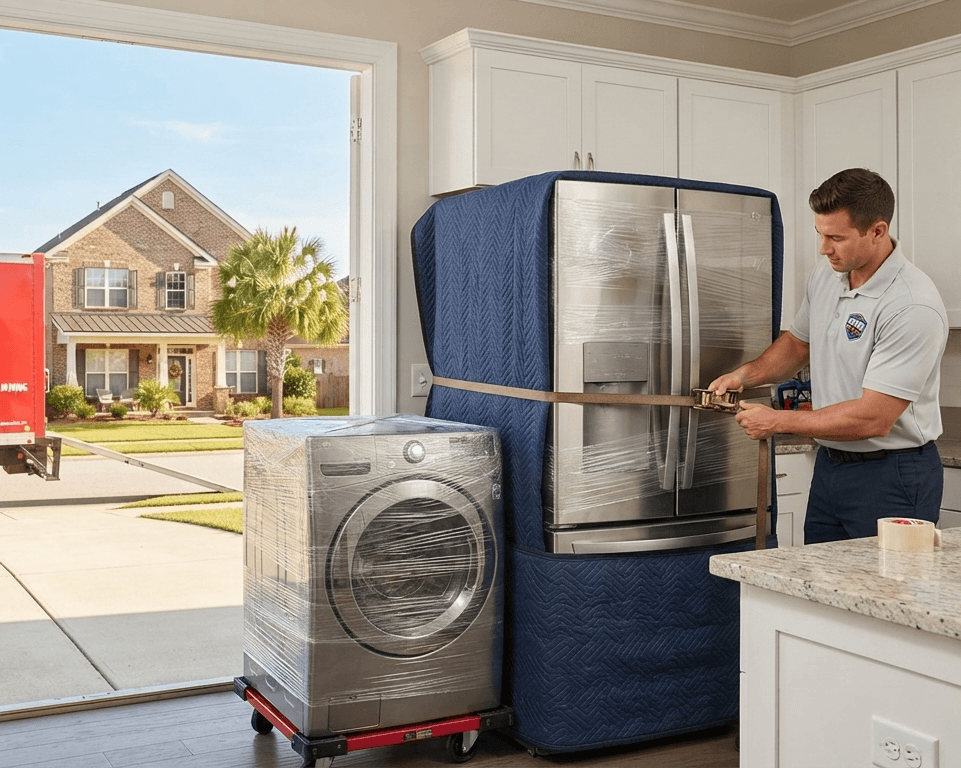
- Cover the refrigerator with moving blankets to protect it from scratches and damage.
- Use an appliance dolly to move it, and keep it in the position recommended by the manufacturer. Most refrigerators are meant to be transported upright, but the instructions can vary depending on the model.
- Once you reach the new location, do not immediately plug the refrigerator in. Check the manufacturer’s instructions to know how long you should wait before switching it on.
Standalone freezers can generally be prepared in the same way by emptying, defrosting if necessary, cleaning, drying, and securing them before transport.
How to pack a Washing Machine
- Front-loaded washing machines need extra care when being moved because their drums are suspended on springs and dampers to reduce vibration during washing. Without proper protection, the drum can move around during transport and potentially damage the machine.
- Before moving the washer:
- Unplug it and turn off the hot and cold water supply.
- Disconnect the water hoses and drain any remaining water into a bucket or onto towels.
- Find the original shipping or transit bolts. If they are missing, check the manufacturer’s website or contact support for replacements.
- Install the shipping bolts in the designated holes at the back of the machine, following the manual.
- Secure and coil the hoses to prevent them from dragging or being crushed.
- Tape the door shut. For top-loaders, secure the lid with a strap or rubber band.
- Use an appliance dolly and keep the washer upright while moving it.
Not all washing machines use shipping bolts, and some top load models do not require them. If your manual does not mention shipping bolts, do not improvise.
How to Pack a Dryer
Packing a dryer for moving starts with a few basic safety steps. First, unplug the dryer from the electrical outlet. Clean the lint trap and the area around it to remove any lint or dust that has collected. Then disconnect the vent hose by following the instructions provided by the manufacturer. Keeping the dryer clean and properly disconnected makes it safer and easier to move.
Electric dryers are usually easier to prepare because they do not have a gas connection. After unplugging the dryer and removing the vent hose, make sure the door is securely closed so it does not open while the dryer is being moved. Protect the outside of the dryer with a moving blanket to prevent scratches, dents, or other damage. When moving it, use a suitable appliance dolly rather than trying to carry it by hand. Dryers can be heavy, and attempting to move one without the right equipment is an excellent way to discover muscles you forgot existed.
Gas dryers require more care because they are connected to a gas supply. You should not try to disconnect the gas connection unless you have the proper knowledge and are authorized to do so. Before moving the dryer, the gas supply needs to be shut off safely. Depending on the manufacturer’s instructions and local safety rules, a qualified professional may need to disconnect and reconnect the appliance.
In simple terms, electric dryers can usually be prepared and moved with proper care, while gas dryers may require professional assistance. Always follow the dryer’s manual and prioritize safety when disconnecting, transporting, and reconnecting the appliance.
How to Pack a Dishwasher
Dishwashers need extra care when you are moving them because they are usually installed inside kitchen cabinets and connected to water and electricity. They are not simply appliances that you can unplug and carry away.
- Before moving the dishwasher, remove the racks and any other loose parts from inside.
- Wrap these parts separately so they do not get damaged or scratch the dishwasher.
- Next, turn off the water supply. The shut off valve is usually located underneath the kitchen sink. Disconnect the water line by following the manufacturer’s instructions. If you are completely removing the dishwasher, you will also need to disconnect the drain line. Some water may still be inside the line or appliance, so keep a towel or bucket nearby to catch any water and prevent it from spilling onto the floor.
- Unplug the dishwasher if it is connected to a regular electrical outlet. However, some dishwashers are directly connected to the home’s electrical wiring instead of being plugged into an outlet. In that situation, do not try to disconnect the electrical connection yourself unless you are properly qualified and permitted to do so. A qualified professional should handle the electrical work when necessary.
- Once the dishwasher has been disconnected safely, protect the front and control panels with a moving blanket to prevent scratches and other damage.
- Keep the appliance stable while sliding it out of the cabinet and when loading it into the moving vehicle.
Always follow the manufacturer’s installation instructions and local electrical safety requirements. Taking a little extra care can prevent water leaks, electrical problems, and damage to the dishwasher or your kitchen.
How to Pack an Oven, Range, or Cooktop
- Freestanding electric ranges: Remove racks and loose trays, clean them, unplug the range, protect the glass door and control panel, and move it carefully with a dolly.
- Freestanding gas ranges: Turn off and disconnect the gas supply with help from a licensed technician. Then remove racks, protect the glass and knobs, and move it carefully.
- Built-in ovens and cooktops: These are often connected to fixed wiring and attached to cabinets, so it is safer to have a qualified professional disconnect and remove them. If you try to do it by yourself, you may damage the cabinet or the appliance.
- For all types: Measure the appliance and the moving route first, and protect glass surfaces with padding.
How to Pack a Microwave
- Clean the microwave inside and outside.
- Take out the glass turntable and its ring, wrap them separately, and pack them carefully because they can easily crack during the move.
- Secure the door with tape so it does not open while being carried.
- Coil and secure the power cord.
- Wrap the microwave in a towel or packing paper and place it in a snug, well-cushioned box.
For built-in or over-the-range microwaves, the setup is usually more complicated because they may be fixed to the wall or connected to wiring. If yours is mounted, treat it like a built-in appliance and get professional help if it involves anything more than simply unplugging it.
How to Pack Small Appliances
Coffee makers, toasters, blenders, mixers, air fryers, toaster ovens, rice cookers, food processors, and electric kettles are easier to pack than large appliances. Still, a little care can prevent damage.
- Clean and completely dry each appliance before packing it.
- Remove loose parts, such as blender blades and mixer attachments, and wrap them separately.
- Give extra protection to glass parts, such as blender jars and coffee carafes, so they do not break.
- Coil and secure the power cord around the appliance, or place it in a labeled bag if you remove it.
- Use the original box if you still have it. Otherwise, use a strong, properly sized box with enough cushioning.
- Do not put too many heavy appliances in one box. The box can become much heavier than it seems.
Protecting Surfaces, Doors, and Drawers
Wrap appliances in moving blankets to protect them from scratches and dents. Cardboard alone may not provide enough protection. For appliances with sharp corners, use extra corner padding. You can use plastic or stretch wrap to keep the blankets in place, but make sure the appliance is completely dry before wrapping it tightly. Moisture trapped under plastic can cause damage.
For doors and drawers, remove any loose items inside so they do not move around during transportation. Secure the doors so they cannot open while moving. You can use tape or straps, but be careful not to damage the surface or door seal. Avoid putting tape directly on delicate surfaces such as stainless steel or glass. If possible, place the tape around an edge instead.
Protecting Floors, Walls, and Doorways
Heavy appliances should never be dragged across the floor. Dragging can scratch or damage hardwood, tiles, vinyl, or laminate flooring, and it can also put unnecessary strain on your back. Use a dolly to move them safely.
- Place moving blankets or floor runners along the path to protect the floor.
- Use cardboard on floors or surfaces that can scratch easily.
- Cover door frames and corners with padding, especially where you need to make tight turns.
- Clear the entire path before you start moving the appliance. Do not try to clear things while carrying it.
Before moving an appliance through a doorway, measure the appliance and the actual doorway space. Remember to consider the door frame and how far the door opens. If the appliance does not fit, do not force it. Sometimes, simply removing the door from its hinges makes the job much easier. It is better to do this beforehand than to get a huge appliance stuck halfway through the doorway.
Moving Appliances on Stairs
Stairs make moving heavy appliances much more difficult and increase the risk of injury or damage.
- Use an appliance dolly made for stairs, preferably one with straps to keep the appliance secure.
- Have enough people to help. Never try to move a heavy appliance down the stairs alone.
- Clear the stairs completely so there is nothing that could cause someone to slip or trip.
- Protect the stairs and walls from scratches and damage.
- Move slowly and communicate clearly with the people helping you.
If the stairs are narrow, have sharp turns, or the appliance is very heavy, it is safer to hire professionals. You can still handle the rest of the move yourself and get professional help just for the stairs.
Loading Appliances Into the Truck and Long Distance Considerations.
Load the heavier appliances first and keep them upright unless the manufacturer says they can be placed another way. Use straps to keep everything secure and prevent things from moving during the journey. Do not place heavy items against refrigerator doors, glass oven doors, or other delicate parts. Keep all doors and drawers secured throughout the journey, not just while loading the truck.
For a long-distance move, appliances experience more handling, shaking, and time on the road. So, use extra padding and make sure everything is firmly secured. After unloading, check every appliance for any damage. Pay extra attention to appliances with compressors or glass parts, as these can be more sensitive to movement.
DIY Cost of Packing Appliances
The cost of moving appliances depends on how many appliances you have and what equipment you already own. A very cheap DIY move can be done using your own blankets and tools, basic tape, and help from friends or family. A basic DIY move may also require renting an appliance dolly, getting moving blankets and straps, and protecting the floors.
If you are moving several large appliances, travelling a long distance, or need to disconnect gas or hardwired appliances, the cost will be higher. You may need to pay for a truck, extra help, and a licensed technician for work that should not be done yourself.
To save money, use the original packaging if you still have it. Borrow moving blankets instead of buying new ones, and rent an appliance dolly instead of purchasing one for a single move. Pack small appliances yourself and hire professionals only for the difficult or risky jobs, such as gas connections, hardwired appliances, or tricky staircases. Also, measure your appliances before renting a truck so you do not pay for more space than you actually need.
Common Appliance Packing Mistakes
- Not checking the manual first. You may miss important instructions for your specific appliance.
- Moving an appliance before it is fully empty and dry. This can cause leaks, mold, or damage inside the appliance.
- Forgetting to secure shelves and drawers. They can move around, break, or get damaged during transport.
- Skipping washing machine shipping bolts. Without them, the drum can move around and get damaged.
- Ignoring refrigerator transport instructions. Moving it the wrong way can cause problems with the compressor.
- Dragging appliances across the floor. This can damage both the appliance and the floor.
- Not measuring doorways beforehand. You may end up with a heavy appliance stuck in the doorway.
- Trying to move a heavy appliance alone. This can easily lead to injuries.
- Forgetting to disconnect water lines properly. Poorly disconnected lines can cause leaks and water damage.
- Trying to disconnect gas or hardwired electrical connections yourself. This can be dangerous and should be handled by a qualified professional.
- Using the wrong wrapping materials. For example, tightly wrapping a damp appliance in plastic can trap moisture and cause problems.
- Losing small parts and hardware. Keep things like shipping bolts and shelf brackets together in a labeled bag.
- Forgetting to protect glass parts. Oven doors, microwave turntables, and other glass parts can easily crack or break.
- Not securing appliances inside the truck. They can move around during transport and damage themselves or other items.
When Does a DIY Appliance Moving Isn't a Good Idea?
Professional help is a good idea when you are moving very heavy appliances, appliances up several flights of stairs, built in appliances, gas connected appliances, or hardwired electrical units. It is also worth getting help if you have a large commercial refrigerator, not enough people to help, physical limitations, a difficult moving route, or valuable property that you do not want to risk damaging.
This does not mean you need to hire a full moving service. You can pack and prepare the appliances you are comfortable handling and hire professionals only for the difficult or risky parts.
Power Movers provides residential, local, and long distance moving services in the Houston area. They also offer labor only and moving help for people who want to handle most of the preparation themselves but need experienced help with heavy or difficult appliances.
In many cases, appliance moving problems start before the appliance even reaches the front door. People often forget to measure the route or check the appliance manual. Getting professional help for the most difficult part can prevent bigger problems and make the rest of the move much easier.
Putting It Together
Packing and moving appliances mainly comes down to good preparation. Check the manual first, empty and dry the appliance completely, and disconnect only the parts that are safe for you to handle. Leave gas and hardwired electrical connections to a licensed professional.
Protect the appliance from scratches and damage, secure doors and loose parts, and use a dolly instead of dragging heavy appliances across the floor. Handle the parts you can safely manage yourself, and get professional help for appliances or staircases that are too heavy or difficult for you and a friend to handle safely.
Before moving, think about whether the appliance can be moved safely on your own or whether it would be better to get experienced movers for the heaviest or most difficult parts.
These shortcuts work fine for everyday flatware, especially on a short move. Formal silver, plated pieces, and antiques are the exception wrap those individually. Metal-on-metal contact is what leaves visible scratches, and those pieces don’t hide damage well.

Article written by
Gary founded Power Movers in 2007 after watching too many moving companies damage or steal from customers with no consequences. The company runs on one rule: every crew member gets background-checked, trained, and held to the same standard Gary was held to as a police officer. Over 9 years in, Power Movers handles local and long-distance moves, specialty items, and corporate relocations for Houston businesses including Tesla and Airgas.