
How to Pack Pillows When Moving: DIY Guide
Once I helped a person who had put all the pillows from his apartment in his car’s back seat in cardboard boxes, and he didn’t know there was something spilled over in the back seat, and most of the pillows soaked up the moisture and smell by morning.
The short answer on how to pack pillows when moving is that each pillow should be placed in a big plastic bag or pillowcase, compressed and packed inside a heavy-duty box or vacuum storage bag and labeled accordingly.
Though the pillows are light in weight, they take lots of space and the trick is to make sure they are protected from moisture and dirt. In case you have limited budget and would do everything by yourself, it will not take much time to pack the pillows properly. Here is how.
Table Of Contents[hide]
Things you'll need
All listed below is easily purchased at a local hardware store and mostly found at home.
- Large moving boxes (wardrobe or extra-large boxes)
- Vacuum storage bags
- Large, clean, heavy-duty plastic garbage bags
- Packing tape
- Permanent marker for labeling
- Work gloves
- Rope or zip ties (for bundling bagged pillows)
- Tape measure
From my experience of moving homes over the years, vacuum storage bags make the best investment when it comes to packing pillows. They reduce volume by over 50%, thus making it possible to pack less boxes and more space in the moving truck.
Things to Check Before Packing Pillows
It is crucial to make sure that pillows are washed and dried prior to packing and sorted by fabric before making a decision about vacuum compression or packing in flexible bags. This stage is always overlooked and, as a rule, becomes a cause for musty and squashed pillows.
- Moisture: pillows should be thoroughly dried in order to avoid the appearance of mold and mildew. Use trash bags and plastic liners to keep dust out and pack pillows in clean pillow cases.
- Weight. Pillows are rather lightweight individually, however, a box full of them, especially memory foam pillows, may become quite heavy. Do not stuff too much into one box only because it seems to have enough space.
- Compression and Materials Limits: Do not compress for long or with extreme force the high density memory foam pillows, as it will ruin the structure of their inner foam layer.
- Dual Use: Store soft pillows separately for usage as natural cushioning and filler between breakable objects and in the moving truck.
- Bag versus Box decision: Use garbage bags for loose and easily compressed load, or boxes, if stacking is needed.
Step-by-Step Guide to Packing Pillows
- Step 1: Sort Pillows by Type
Memory foam, down and feather, and synthetic pillows should be separated before beginning the packing process. All types are different in terms of pressure tolerance and moisture resistance, so the separation will help understand how to pack particular type of the pillows.
Memory foam pillows are dense and slowly decompress, so they need more care. Down and feather pillows compress well but can change shape and clump during too strong and prolonged compression. The most common mistake is assuming that all pillows are alike and treating them the same way, what leads to the damage of the denser memory foam pillows.
- Step 2: Wash or Air Out Pillows Before Packing
If the pillow has not been cleaned in some time, take a moment to air out or clean it quickly before packing it away. It’s much easier to trap odors and moisture by packing your pillow in plastic bags without giving it a chance to get rid of any moisture.
This is more important than most people think, especially in case of long distance relocation when pillows could be packed for several days. Even if there isn’t enough time to clean pillows, it would be good at least to air out for an hour so that all moisture could dissipate.
- Step 3: Add a Moisture Barrier
Put the pillow in a plastic garbage bag or a pillowcase before putting it in boxes. Such an additional layer protects pillows from dust and moisture while the moving truck is getting wet or the storage unit is a bit humid.
This is one of those mistakes that homeowners tend to make often, especially when packing in haste. Even a little dampness of pillows during relocation could cause unpleasant musty odors just a few days after.
- Step 4: Compress the Pillows
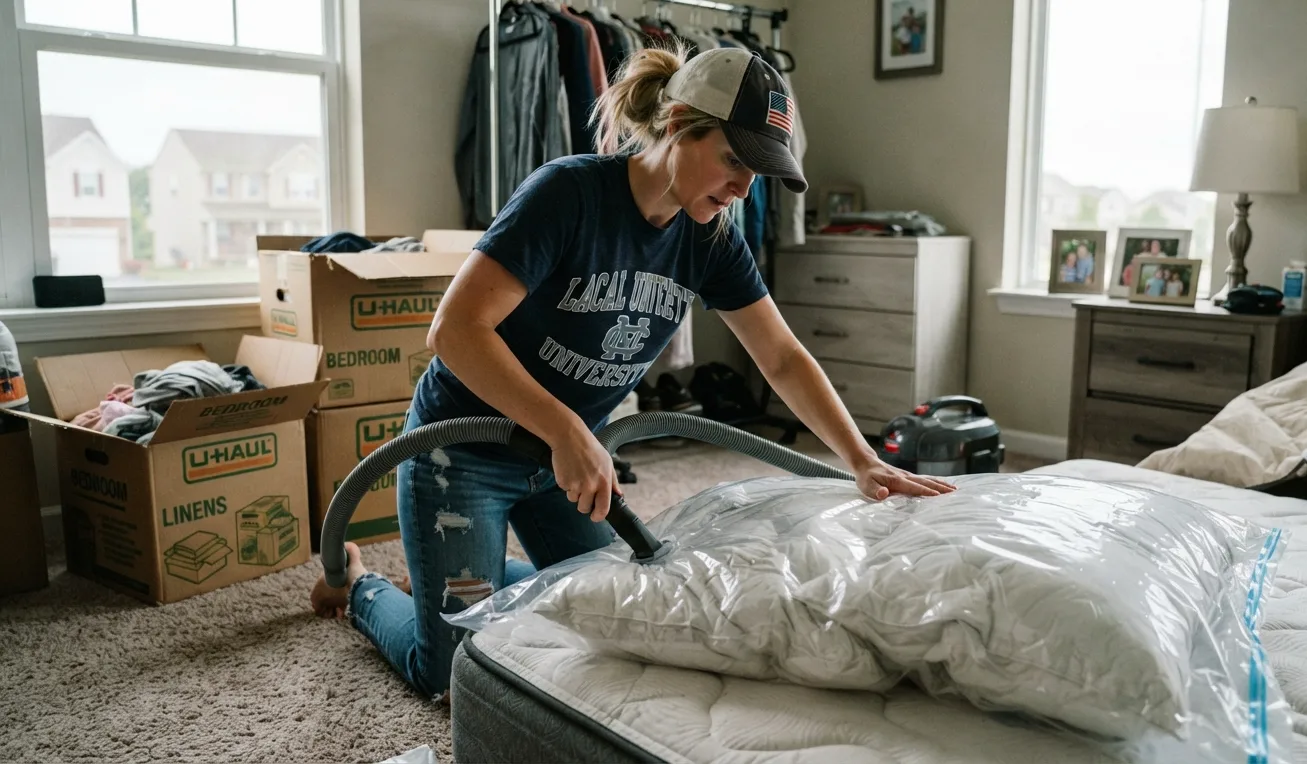
If placing pillows inside a vacuum storage bag, add two or three at once, seal the opening, and then vacuum the air from the bag using either your vacuum cleaner or the valve provided on the bag itself. In this manner, you will easily be able to reduce a pile of pillows to a fraction of its original volume.
Please note that such method is not suitable for memory foam pillows, as the strong vacuum can harm the material. Thus, vacuuming down, feather, and synthetic pillows is perfectly okay, while memory foam pillows are best not heavily compressed or compressed at all.
- Step 5: Pack Pillows Into Boxes
Lining the bottom of a sturdy cardboard box with a blanket or towel, start filling the box with your bagged or vacuumed pillows. You should fill the gaps between pillows with smaller pillows inside bags if necessary.
Please note that you should not stuff one box with too many pillows since even though pillows seem to be very soft and light, overfilled box is difficult to carry and might get dropped, which is dangerous if you are combining boxes.
- Step 6: Seal and Label the Box
Seal the box by taping it securely at the top and bottom folds, and label it with your permanent marker. “Pillows” and the specific room name, for example, “Pillows, Master Bedroom.”
Labeling takes thirty seconds and will save valuable time. From experience of helping many families move house over the years, I can say that unmarked pillow boxes tend to be lost more often than any other boxes, as they are easily covered with other, heavier boxes.
- Step 7: Load Pillow Boxes Strategically
Place the boxes with pillows towards the top of your moving truck or stack because they are light and cannot crush any items placed beneath them. Do not put any heavy boxes on top of the boxes with pillows; this can damage foam pillows or change their shape.
In case you have pillows instead of boxes with pillows used for extra protection, do not forget to pack the pillows in bags. They can get dirty, scuffed and dusty when being in contact with furniture.
Special Situations
Packing Pillows for a Long-Distance or Storage Move
In case the pillows are stored for a longer period of time in either a moving van or storage unit, it is even more important to think of moisture control issues. In case you have any available moisture absorber packets, place them inside the vacuum bags or boxes together with the pillows, since plastic bags can retain some moisture even after being sealed.
In case you have access to the storage unit, check the pillows stored there every two or three months, since a little bit of ventilation will help prevent the musty smell caused by unattended moisture.
Packing Pillows With Limited Boxes or Supplies
If you don’t have enough boxes, large heavy-duty garbage bags will suffice if used for a very short period of time. These bags should be securely tied, and you should mark them with a marker right on the bag itself.
Of course, it would be better to use boxes, but this solution may be acceptable for a short distance move in one day.
It is just necessary to put the pillows into bags only if they won’t come in contact with anything sharp or heavy in the moving van.
Packing Decorative or Specialty Pillows
Special pillows that have beadwork or embroidery should be handled with extra care and not vacuumed compressed because the vacuuming process might damage them. Place these pillows separately inside a soft material before putting them in the packing bag.
For pillows that contain special filler material such as buckwheat, do not use compression vacuuming on them because the fill will move to one end of the pillow.
A few precautionary notes about your packing materials. The US Consumer Product Safety Commission has issued warnings for years that plastic bags, including the packing garbage bags and dry cleaning bags, are a potential suffocation hazard to small children and pets. Do not leave any loose plastic bags lying around while you are packing.
Common Mistakes to Avoid
- Skipping the moisture barrier when packing pillows loosely
- Vacuum-compressing memory foam pillows excessively
- Over-packing one box such that it becomes too heavy to carry
- Failing to label the pillow boxes and allowing them to get lost among other heavier boxes
- Packing dirty and musty pillows without letting them air out
- Piling up heavy boxes on top of the pillow boxes Leaving the plastic bags loose and accessible to kids and pets
These errors are fairly easy to avoid once you know about them; yet, they are the reasons behind most of the pillow damages and lost items I come across after moves.
When You Should Call Professional Movers
DIY packing and moving of pillows is one of the more easily accomplishable aspects of a DIY move, and most people manage it with little effort. There are occasions, however, when it makes sense to get help from professionals.
Should you be overseeing an entire house move with insufficient time, many specialty pillows in your household, or a long-distance move where proper packing is especially important, then professional movers are equipped with knowledge and tools to accomplish it.
When Professional Movers Can Help?
DIY packing and moving of pillows is one of the more easily accomplishable aspects of a DIY move, and most people manage it with little effort. There are occasions, however, when it makes sense to get help from professionals.
Should you be overseeing an entire house move with insufficient time, many specialty pillows in your household, or a long-distance move where proper packing is especially important, then professional movers are equipped with knowledge and tools to accomplish it.
Professional companies such as Power Movers do complete packing of homes on a regular basis, which will prevent homeowners from incurring any property damage, physical injury, or replacement cost of items damaged or lost during packing.
If you plan to relocate your fragile decorative pillows or valuable bedding or you just lack the time to complete the task, then it is a good idea to get some assistance.
Conclusion
The process of packing pillows for a move requires several basic rules: grouping by type, providing a moisture barrier, compressing, and labeling. Just follow the guidelines provided above and your pillows will be delivered in perfect shape.
If packing list looks longer than the time you have left, do not forget about Power Movers’ assistance and moving services.
No matter whether you will pack pillows on your own or hire a whole team for the move the result will be one and the same: relocation of your family to a new house. Are you ready to pack?

Article written by
Gary founded Power Movers in 2007 after watching too many moving companies damage or steal from customers with no consequences. The company runs on one rule: every crew member gets background-checked, trained, and held to the same standard Gary was held to as a police officer. Over 9 years in, Power Movers handles local and long-distance moves, specialty items, and corporate relocations for Houston businesses including Tesla and Airgas.