
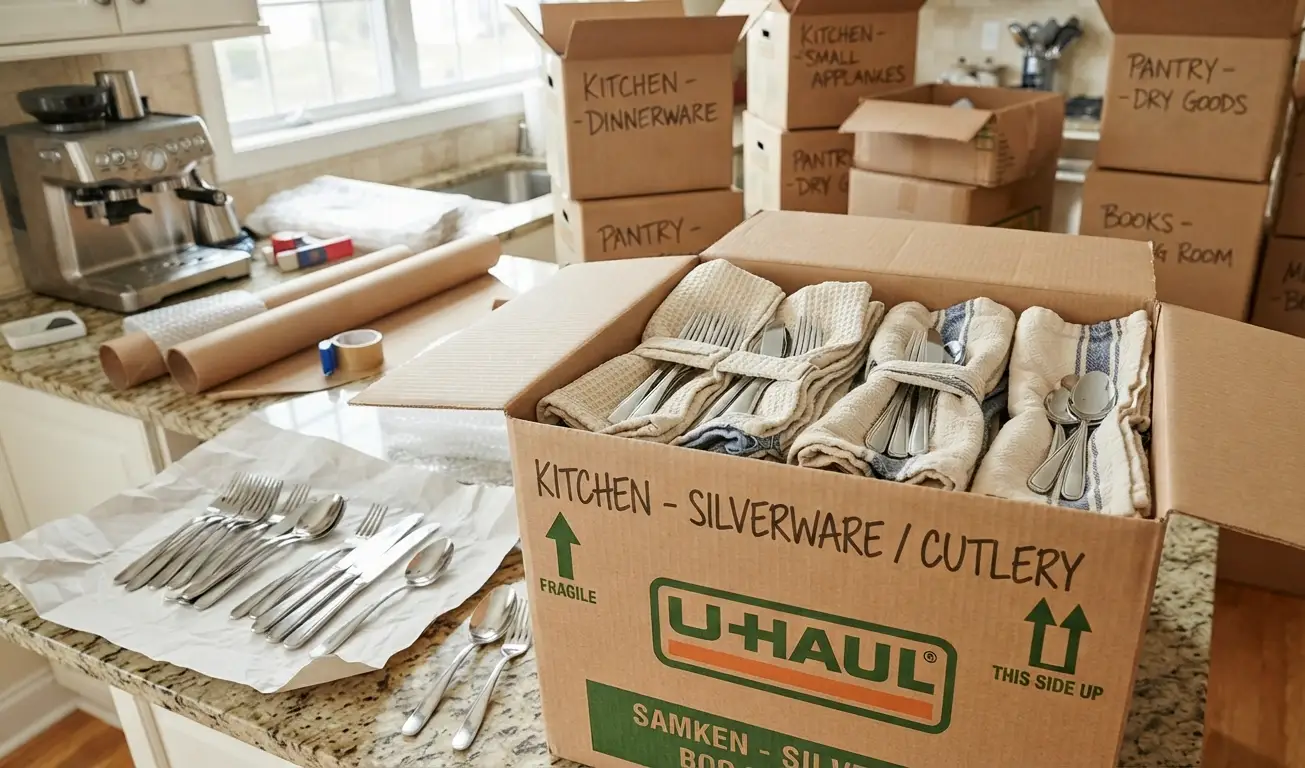
How to Pack Silverware for Moving: Step-by-Step Guide
I unpacked a kitchen a few years back and found the family’s silver serving spoons all scratched to hell. Turns out they’d gone into a box loose, mixed in with everyday stainless steel forks. Nobody meant to wreck them. They just dumped the drawer into a box and taped it shut, the way most people do.
So here’s the short version: sort by type and value before anything else touches a box. Bundle similar pieces together so they’re not rattling around and rubbing on each other. Pack snug, pad the gaps, label the box. That’s really it. Almost every scratched-up silverware set I’ve seen comes down to one thing stuff packed loose and mixed together.
If you’re doing your own kitchen and trying not to spend money you don’t have to, this whole process adds maybe twenty extra minutes. Worth it.
Table Of Contents[hide]
Things you'll need
Nothing fancy a hardware store or grocery store covers all of it:
- Small moving boxes
- Medium moving boxes
- Packing paper
- Bubble wrap
- Zip-top bags
- Rubber bands
- Plastic wrap
- Kitchen towels
- Dish towels
- Labels
- Permanent marker
- Packing tape
- Dividers (if you’ve got them)
Go small on the boxes. I know it feels like everything should fit in one big box, but silverware is deceptively heavy a medium box packed solid with flatware gets miserable to carry real fast.
Things to Do Before Packing Silverware
- Wash and dry it all first. Leftover food gunk sitting sealed in a box for a week can spot or corrode pieces, and it's not something you want to discover on the other end.
- Keep your everyday stainless steel away from anything silver-plated or sterling. Stainless is harder than silver, so if they rub together in transit, the silver will get scratched.
- Dry each piece by hand even if it looks dry. Trapped moisture in a sealed box is a sneaky cause of tarnish you won't see it until you unpack.
- Sort by type, forks with forks, spoons with spoons, knives with knives.
- If you've got a formal set, count the pieces before it goes anywhere. That way you know instantly if something's missing later, instead of wondering for weeks.
- Antique or inherited pieces get their own box. The detailing is more delicate, the metal's often softer, and they deserve more padding than the everyday stuff.
Step-by-Step Guide to Packing Silverware
- Step 1: Sort Everything by Type and Value
Lay it all out everyday stainless, formal or plated sets, antiques and split into groups. This is the step people skip because it feels slow, and it’s exactly why so many silverware sets show up scratched. Dumping a whole drawer into one box is fast in the moment and a headache later.
- Step 2: Wrap Knives Separately for Safety
Roll each knife in packing paper or a folded towel, tape or rubber-band it shut. This isn’t just about the blade it’s about whoever reaches into that box next not slicing a finger open. Don’t skip this for a “quick” local move either. It takes two minutes.
- Step 3: Bundle Similar Utensils Together
Groups of four to six a handful of forks, a handful of spoons rubber-banded together before wrapping. This keeps sets together and stops individual pieces from sliding around and scraping each other. It also makes unpacking way less annoying, since you’re placing whole bundles into a drawer instead of sorting one piece at a time.
- Step 4: Add a Layer of Padding
Line the bottom of the box with paper or a towel before anything goes in, then add another layer between bundles. This is what absorbs the bumps during the actual drive without it, everything just knocks around.
- Step 5: Pack the Box Snugly
Fill the box until it’s full but not stuffed, using paper or a spare towel to plug any gaps. Empty space is basically an invitation for things to shift and scratch each other. And watch the weight the Consumer Product Safety Commission’s advice on lifting safely applies here too, since a “small” box of flatware adds up fast.
- Step 6: Seal and Label the Box Clearly
Tape it up, write “Silverware Fragile” (or note if it’s the good stuff) right on top. Skipping this is a bigger mistake than people expect an unlabeled silverware box has a way of ending up at the bottom of a stack, forgotten until week two.
How to Pack Silverware for Moving Without Wrapping
You don’t have to. A few shortcuts that still get the job done:
- Bundle and rubber-band. Same as above four to six pieces, shared wrap, done.
- Zip-top bags. Toss a bundle in a bag. Keeps moisture out, takes ten seconds.
- Roll in a kitchen towel. You’re already packing the towels anyway might as well use one to cushion a bundle instead of buying more paper.
- Move the whole silverware tray. If your flatware already lives in a tray, just wrap the tray in plastic wrap or a towel and move it as one unit. No reason to take it apart.
- Same goes for drawer organizers lift it out, wrap it, box it. Keeps your system intact so unpacking is basically instant.
- Stand pieces upright in a bin. Handles up, points down, in a small box or plastic container. Keeps them separated with zero individual wrapping.
These shortcuts work fine for everyday flatware, especially on a short move. Formal silver, plated pieces, and antiques are the exception wrap those individually. Metal-on-metal contact is what leaves visible scratches, and those pieces don’t hide damage well.
Should You Wrap Every Piece Individually?
Individual wrapping isn’t always necessary, and knowing when to skip it saves real time during a move.
- Stainless steel durable enough to handle bundling or a tray without individual wrapping. It shrugs off scratches better than softer metals.
- Everyday flatware rarely needs individual wrapping. Bundle it, bag it, or leave it in its tray.
Silver-plated the plating is thin and soft, so individual wrapping is worth the extra ten minutes to avoid visible scratches. - Antique silver wrap every piece, every time. The National Park Service’s guidelines on handling silver artifacts stress keeping it separated from other metals to avoid scratching and tarnish the same logic holds for a move.
Common Mistakes to Avoid
- Packing silverware while it's still wet
- Overloading boxes until they're too heavy to lift safely
- Mixing knives loosely with other delicate utensils
- Leaving empty space inside boxes that allows shifting
- Using oversized boxes that make heavy items harder to carry
- Packing valuable silver together with everyday stainless steel
After packing hundreds of kitchens, these are the same mistakes I see again and again. Every one of them is avoidable with just a little extra planning before you start taping boxes shut.
Professional Packing Tips
Pack the silverware near the end you’ll want a fork until the last possible minute. Set aside a small bag of everyday utensils for your essentials box so you’re not tearing open sealed boxes on night one in the new place.
If you’re moving more than one silverware set, number the boxes so you can confirm nothing’s missing later. And keep your bundles consistent four to six pieces each so unpacking feels organized instead of like sorting a junk drawer.
When Professional Movers Can Help?
Most people can handle this themselves, especially with a basic everyday set. But if you’ve got a big kitchen with an extensive collection, real fine silver, or a full formal dining set, professional packing materials and experience start to matter more.
Long-distance moves raise the stakes too more time in transit, more handling along the way. Power Movers offers specialty packing for households with valuable kitchen collections, which can be worth it if you’re short on time or just don’t want to risk it.
If your move is big and your timeline is tight, or you’ve got pieces you genuinely couldn’t replace, that’s a reasonable point to ask for help instead of rushing it yourself.
Conclusion
Sort by type and value, bundle or wrap with some thought behind it, pad the box, pack it snug, and label it before you seal it up. Do that and your silverware shows up scratch-free and ready to use.
If your kitchen packing list is bigger than your patience, Power Movers and other Residential Moving & Local Moving pros are there as a backup. Whether you pack it yourself or hand it off, the point’s the same protecting the stuff that actually matters to you. Ready to get started?

Article written by
Gary founded Power Movers in 2007 after watching too many moving companies damage or steal from customers with no consequences. The company runs on one rule: every crew member gets background-checked, trained, and held to the same standard Gary was held to as a police officer. Over 9 years in, Power Movers handles local and long-distance moves, specialty items, and corporate relocations for Houston businesses including Tesla and Airgas.