
How to Wrap a Sofa for Moving: 101 Guide
There was an instance when I came to the house for packing purposes only to see that the homeowner had attached bedsheets to their leather sofa via taping them the previous day because it was going to protect the sofa during the move. However, by the time we arrived, the tape had made sticky stains on the leather sofa that took quite some time to wash away.
How to wrap a sofa for moving in short?
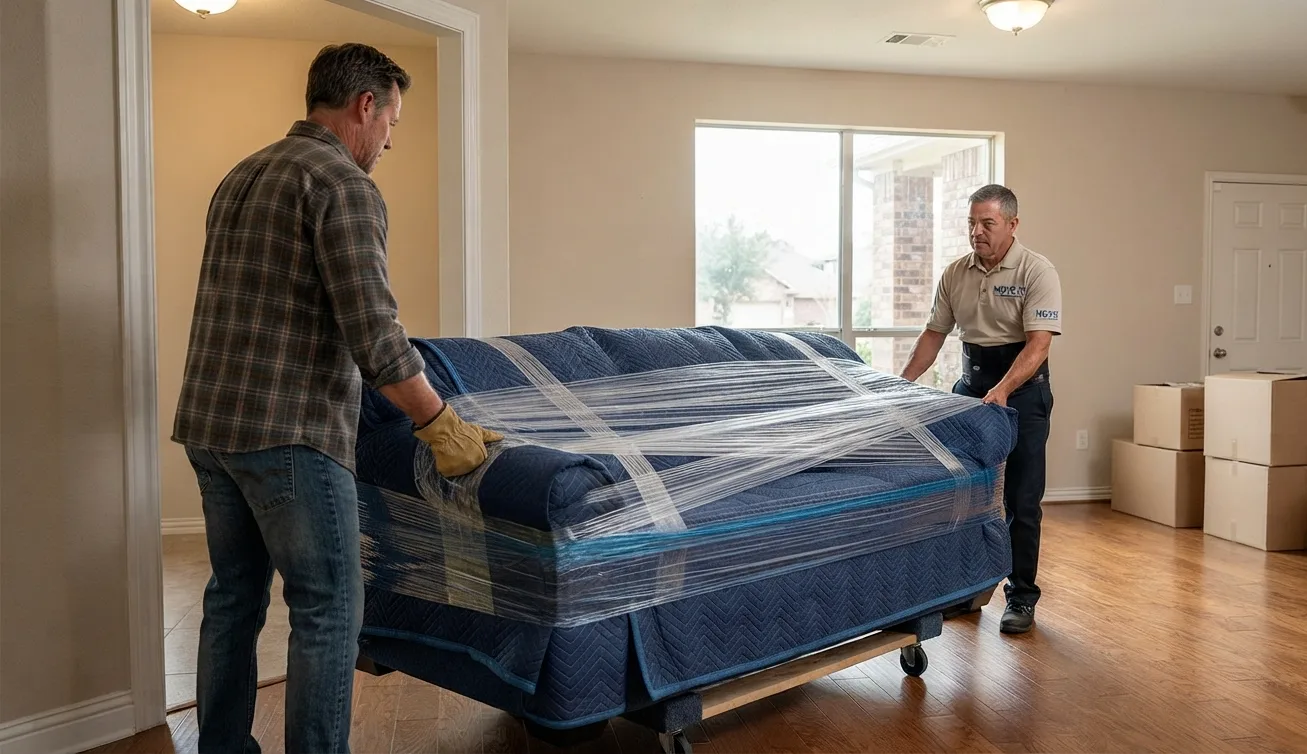
The answer is removing the cushions from the sofa and wrapping the frame first in moving blankets for cushioning, then wrapping plastic stretch wrap around those blankets for holding all layers in place, but keeping the plastic a little bit loose to allow moisture evaporation. The layer of blankets will help with protecting your sofa from scuffs and pressure marks, whereas the plastic one from dust and dirt during the transportation process.
Proper wrapping of a sofa while moving on a budget and without professional help only takes about fifteen-twenty minutes once you know the right way of doing it. This is how you should proceed.
Table Of Contents[hide]
Things you'll need
All the items listed above can be found in any nearby hardware store and some of them at home.
- Moving blankets
- Furniture pads
- Plastic stretch wrap
- Packing tape
- Cardboard corner protectors
- Furniture sliders
- Furniture dolly
- Forearm forklift straps
- Work gloves
- Hex keys
- Screwdriver
- Rope
One of the best but least talked about tools in this list is the forearm forklift straps. They allow two movers to carry a heavy sofa while lifting it with their forearms and shoulders rather than the lower back muscles. It can really come in handy especially when moving the heavy sofa across the distance to the truck.
Things to Check Before Wrapping a Sofa
Before going to grab the plastic wrap, spend a minute or two checking these things. You might be surprised to learn that this step is frequently skipped, and the only reason for that is the damaged sofa during the move.
- Inspect your sofa for pre-existing damages: Check the sofa carefully for scratches, dents, loose legs, ripped upholstery or worn-out spots. It is recommended to take photos of the sofa prior to the packing in order to spot any new damages after the move.
- Clean the sofa properly: Vacuum your sofa carefully, remove all dust, pet hairs, crumbs and wipe leather or wooden surfaces. Wrapping a dirty sofa can cause moisture and dirt to accumulate inside it resulting in fabric damage.
- Detach all removable pieces: Try to detach cushions, legs, armrests, headrests, and decorative pillows if possible. Put the detached pieces into separate boxes and mark them in order to facilitate the process of reassembly after the move.
- Fasten all loose components: In case some parts of your sofa cannot be detached from it, attach them carefully with the use of tapes, straps or stretch wrap. It will help to avoid unnecessary movements and thus reduce the risk of damage.
- Select proper packaging material: Collect moving blankets, stretch wrap, furniture coverings, packing tape, corner protection pads, and bubble wrap for sensitive spots. The use of correct packing materials offers additional protection against scratches, dust, and water.
- Arrange the moving process: Get rid of any objects on the way from your sofa to your moving truck. Remove floor rugs, other furniture, and any decorative items that may interfere in the moving process and become a hindrance.
Step-by-Step Guide to Packing Silverware
- Step 1: Measure Doorways and Hallways First
Before wrapping any furniture, measure the height, width, and depth of your sofa. Check these measurements against the dimensions of your doorways, halls, and staircases to find out whether the sofa will be moved in one piece or it will have to be disassembled and carried in some different manner.
This is one of the most common mistakes I see people making before moving their furniture, especially when it comes to sectional sofas and sofas with large armrests. Not finding out about the non-fitting of a sofa until it has been properly wrapped means having to unwrap it all.
- Step 2: Remove Cushions and Detachable Parts
Remove the seat cushions and back pillows and store them separately for wrapping. The reason for removing the slipcover if you have one is the same – to avoid bunching and possible tearing of the cover during the move.
It is easier to lift and move the sofa after you remove these parts since you have more room to work with. In addition, it will help to wrap the sofa correctly and avoid uneven padding due to cushioned areas inside the wrap.
- Step 3: Detach Legs and Other Removable Components
Sofa legs should be removed if there is any hardware that allows you to take them apart. Keep them in a small bag and label the bag clearly so that you do not lose the screws while moving.
The fact is, sofa legs are the most frequently lost items during a move and it takes time and effort to assemble the sofa again if there are some mismatched or missing hardware elements. If the leg is not easily removable, try not to force it since you may strip the screw thread.
- Step 4: Check for Recliner Mechanisms or Moving Parts
Where the sofa includes a reclining mechanism or pull-out bed frame, refer to the manufacturer instructions where possible as it may require locking or securing for the move. The unsecured recliner mechanism of the sofa will shift during transit causing unexpected extension and shifting of the frame while loading the vehicle.
An example of this is when homeowners wrap the recliner without ensuring this first, which in turn causes the mechanism to jam or bend. Where there is doubt on how to secure it, simply placing a couple of wraps of rope or moving straps around the sofa’s base will prevent its opening while in transit.
- Step 5: Wrap the Frame in Moving Blankets
Cover the entire sofa with moving blankets or furniture pads, ensuring that all of the corners as well as the armrests and backrests are covered. Secure the coverings with packing tape or rope, taking care not to put the tape directly on the fabric or leather upholstery of the sofa.
It is the cushioning provided by these coverings that prevent any damage to the sofa such as scuffing, pressure marks, and tearing of the fabric. Placing plastic coverings without cushioning beforehand is the biggest error I have observed because it provides very little protection to the sofa.
- Step 6: Add Plastic Stretch Wrap Over the Blankets
After securing the blankets, encase your sofa in plastic stretch wrap, wrapping it tightly around the sofa in order to secure the blankets as well as add another protective layer to prevent dust and moisture from settling on it. Wrap your sofa in overlapping layers, starting from one end of the sofa and moving across to the other, using as many rolls as necessary.
Keep one area of the sofa uncovered or loosely wrapped in order to give moisture a way to escape instead of staying trapped in the plastic against the material of the sofa. Leather sofa upholstery can discolor from heat that can be trapped when plastic is tightly wrapped around it for an extended amount of time, so try not to keep your leather sofa encased in plastic for more than a day or two.
- Step 7: Protect the Corners
Slide some cardboard corner protectors on to any exposed corners or edges of wood in your sofa before moving it. This will prevent the most frequent kind of damage I come across, which is corner dings that result from bumping your sofa against doorways, walls, and stair railings.
In case you do not have any corner protectors, a folded moving blanket that is taped securely around each corner can do the job. Make sure it doesn’t move during the transportation.
- Step 8: Load the Sofa Using Sliders and a Dolly
Place the sliders under the legs or base of the sofa to facilitate sliding on the floor, but not lifting the whole piece of furniture when transporting across flat ground. Once on the truck ramp or on the steps, use a furniture dolly for straight and level sections of the path.
When necessary, turn the sofa on its side to pass through a narrow doorway and always have someone spot the turns and the tilting process. Lift the sofa with the help of your legs and not your back, and place it gently on the ground rather than dropping after loading it.
Special Situations
Wrapping a Leather Sofa
The leather upholstery requires some extra attention, as leather can get scratched and scuffed, and can also suffer from long-term contact with plastic. Put the soft moving blanket as the first protective layer, and check the sofa from time to time if the packing will take more than a day.
Wrapping a Sectional Sofa
Sectional sofas should be dismantled into separate pieces before the wrapping because the majority of sectional sofa pieces come apart at the point of connection. Wrap and label all parts separately, indicating which side of the part connects to another.
Moving a Sofa Down a Narrow Stairwell
A narrow staircase is one of those tougher scenarios you’ll come across, and it might become necessary to tilt the sofa at an angle. It’s never wise to do it on your own if the sofa is really heavy because any imbalance on the stairs can cause an accident.
In case the stairwell is really narrow and has a curve, then this is a scenario where it’s better to hire an additional person or a professional team.
Common Mistakes to Avoid
- Wrapping in plastic without the use of a blanket under it first
- Taping directly on the fabric/leather material
- Over-sealing the sofa in plastic for too long
- Neglecting to measure doorways and hallways
- Loss of hardware due to the detachment of legs
- Doing the narrow staircase move on your own
- Overlooking the recliner mechanism when wrapping
I’ve helped many families move in the past couple of decades and these are the same mistakes that I encounter all over again. These don’t even cost anything to avoid, only a bit of prior planning is needed.
When Professional Movers Can Help?
DIY wrapping and transporting is an optimal solution for most families, assuming that the sofa is not overly large and the way from the house to the truck is not complicated. However, there are situations when hiring some professionals will be more beneficial compared to doing everything by oneself.
For example, in case of oversize furniture, narrow staircases or doorways, and transportation of a heavyweight sectional, professional movers will do the job easier, quicker, and without risks for the customer’s health or the apartment’s furniture.
This service is often offered by furniture moving companies like Power Movers, who help homeowners save their property from damage and injuries and avoid extra costs of replacement of their sofa or repairing of damaged walls or doors.
In addition, in case of inability to move heavy furniture manually, it is a valid reason to hire professional movers rather than damage one’s health or sofa.
Conclusion
Wrapping of a sofa in case of transportation is based on the following sequence of actions: measuring, removing removable parts of a sofa, covering with blankets and with plastic, leaving gaps between the material and the furniture. Following the recommendations above, one will make sure that his or her sofa is free from tears, scuffs, and pressure marks.
Whether you wrap and move the sofa yourself or bring in a crew, the goal is the same: getting your furniture to its new home safely. Are you ready to get started on your move?

Article written by
Gary founded Power Movers in 2007 after watching too many moving companies damage or steal from customers with no consequences. The company runs on one rule: every crew member gets background-checked, trained, and held to the same standard Gary was held to as a police officer. Over 9 years in, Power Movers handles local and long-distance moves, specialty items, and corporate relocations for Houston businesses including Tesla and Airgas.